SOULQUEST – On indefinite hiatus

Some keen-eyed visitors may realize that the “Serial Fiction” section of this site is now gone. I just received an e-mail from Ian Mileham who runs the Revenance Original Fiction site. Ian has been through some difficulties as of late, and so he wasn’t able to devote time to the site. This is why only the first chapter of my SoulQuest serial was posted. The second chapter had been written, but was never posted due to Ian’s difficulties.

Unfortunately now, Ian has said that his online presence will basically be nil. Whether or not Revenance continues with someone else remains to be seen. I hope it will as there’s some really great stuff over there.

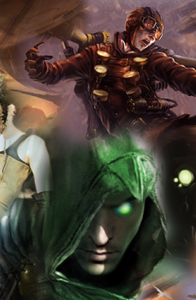
As of right now, this means the future of SoulQuest is very much in question. It’s a bit of a shame, really, as this series seems to be plagued with setbacks. It started out as a comic project I came up with specifically tailored to an artist who wanted to work on a project with me. He did two character designs then vanished. Not long after that, I met another artist who contributed a lot to the concept and came up with some really great designs. After about a year of development, he too vanished without a word.

I was hoping Revenance would be a new home for the series but it looks like that’s gone silent as well. At the moment, I’m directing most of my efforts into Dragon Kings of the Orient, which will be the sequel to my upcoming novel, The Myth Hunter. And Tommy and I are about to break ground on The Adventures of Nicholas Saint, which we’ll want to have ready to go in time for the Christmas season.

So SoulQuest? For now, no. Sorry to those who read the first chapter and really enjoyed it. I do plan on coming back to it some day. Love & Bullets and The Myth Hunter started out as concepts that died and were later resurrected. SoulQuest could easily join them in the future.

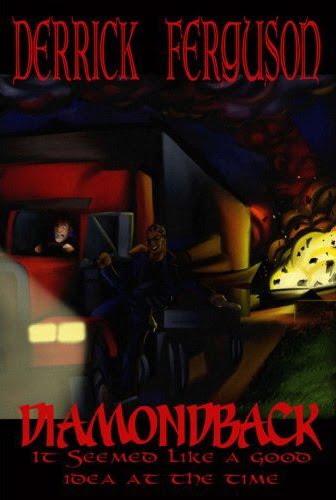
Diamondback: It Seemed Like A Good Idea At The Time

Ever since I read Derrick’s first book, Dillon and the Voice of Odin, I’ve been sold on his work. Derrick has a knack for intriguing characters, snappy dialogue, and some of the best action I’ve had the privilege of reading.

Whereas Derrick’s Dillon series (as of this writing composed of Dillon and the Voice of Odin and the follow-up Dillon and the Legend of the Golden Bell) is a love letter to Doc Savage and the classic adventure story, Diamondback is a true spaghetti western. But like with Dillon, Derrick mixes his love of the classics with a modern sensibility. Derrick has frequently referred to this story as an urban western and that’s the most apt description I can think of.

Although this story could have been set in the Old West out on the frontier, it fits perfectly in the fictional city of Denbrook, which could easily give Gotham a run for its money.

When one of Denbrook’s biggest crime lords is planning to bring in a shipment of hi-tech weapons, it just so happens to coincide with the arrival of gun-for-hire Diamondback Vogel. And this is one mercenary who is the best there is at what he does and what he does is fill his enemies with lead and leave a trail of destruction in his wake. Crime lords, crooked cops, and secret societies are all involved and all interested in Diamondback’s role in this tale. However, Diamondback supposedly died in a shootout in another town, so one of the ongoing questions is just who is this guy? It’s a question that plays no small role in this story and I’m not going to say anything more about that, because you’re better off reading it for yourself.

What I will tell you is this is a great read that won’t suck up a lot of your time. Not only because it’s a short book, but also because Derrick wastes no words. He knows you’re here for the action and he gives it to you in abundance. The action sequences are crafted with both bloody intensity and a flawless grace that would make even John Woo envious. And by the time you reach the last page, you’ll want to track this Ferguson guy down and find out when the sequel is coming, because he leaves you with a cliffhanger ending that will put you on the edge of your seat.

But don’t take my word for it — see for yourself. Diamondback: It Seemed Like A Good Idea At The Time is available on Amazon for $10.95.

News on THE MYTH HUNTER

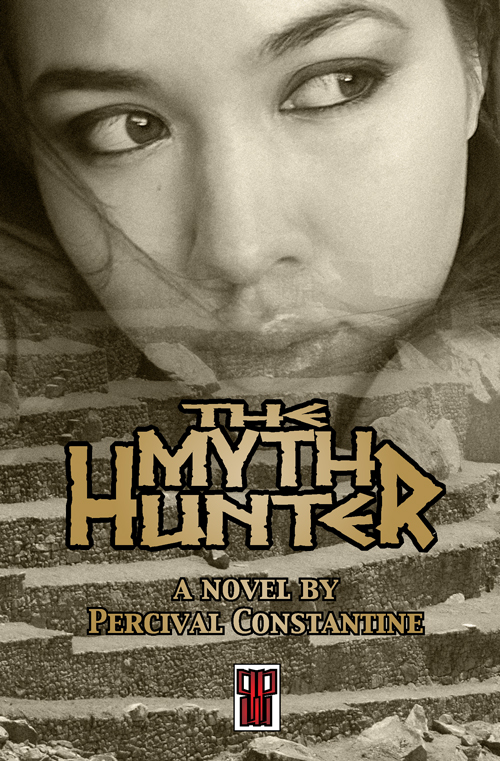
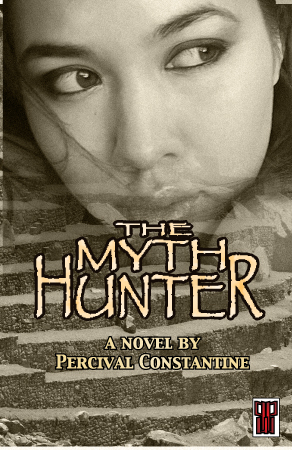
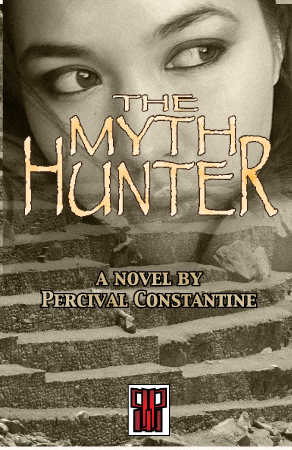
To the left, you’ll see the revised cover for The Myth Hunter. This change came about after a friend pointed out that the font I had used for the previous design, which was Papyrus, was a big mistake.

You’d think being a guy who cut his teeth in the publishing world by doing comic book lettering and logo design, I would have known better than to use one of the five terrible fonts you shouldn’t use in print design.

Anyway, realizing the mistake I made in what was otherwise probably the best cover I’ve designed to date, I went ahead and changed the logo to what you now see on the left. If you remember the old design, or if you search through this site to find it, I think you’ll agree.

Strange thing is this is a font I already have in my library to begin with, so I’m not sure why I didn’t go with it instead of Papyrus. Just one of those brain farts I’ve been known to have on occasion, I suppose.

The book itself is moving closer and closer to production. I’ve gotten some good comments on how to tighten it up and help improve the pacing. Right now, we’re looking at a release date of May or June, so more information to follow with that.

While we’re on the subject of The Myth Hunter, I’ve also begun work on the sequel, Dragon Kings of the Orient. I got the idea for it while I was doing research on the first book, stumbled upon some concepts that I thought were awesome, and decided to save them for the sequel. Glad I did, because the more research I’ve done, the more I’ve found stuff I really wanted to use.

The Myth Hunter focuses on the legend of the lost continent of Lemuria, which is also known as Mu. It’ll take the protagonist, Elisa Hill, from the waters of the Caribbean to the temples of India and the Ryukyu Islands of Japan.

Also for some more added goodness, I’ve done several revisions on Outlaw Blues, the follow-up to Love & Bullets. That book is due for a release either at the end of this year or at the beginning of 2012.

And Tommy Hancock of Pro Se Productions and I have recently decided to team up on a project called The Adventures of Nicholas Saint. If you read Tommy’s “Ideas Like Bullets” column over at All Pulp, you’ll already have heard of this concept. If you haven’t, I’ll make it easy for you — imagine a character who’s a cross between Doc Savage and…Santa Claus. Oh yeah, it’s gonna be fun.

And last but certainly not least is Airship 27’s All Star Pulp Comics. This all started out when Ron Fortier of Airship 27 did an interview where he expressed an interest in releasing more comics. Several years earlier, I had attempted to self-publish a pulp anthology featuring separate creative teams doing eight-page stories featuring public domain pulp characters. Unfortunately, only two teams completed their stories and the project fell through. So I contacted Ron and said, “hey, I’ve got these stories here that some guys did and I’d like to see them get their work recognized. You have any interest?”

Well, Ron loved them and used them as the basis for All Star Pulp Comics and gathered a bunch of other talented guys to contribute their own stories. The project is still a way’s off to completion, but since again it was announced on The Book Cave, I feel I can mention it here. So I’m really excited about that project as well.

The Green Hornet (2011)

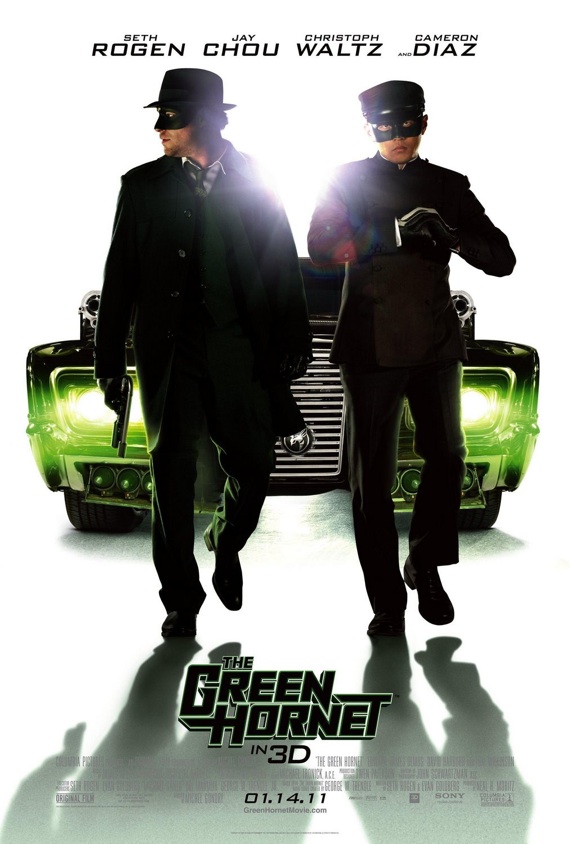
THE GREEN HORNET (2011)

Directed by Michel Gondry
Written by Seth Green and Evan Goldberg
Starring Seth Rogen, Jay Chou, Christoph Waltz and Cameron Diaz

Every so often, there comes a movie that raises the bar. That manages to do something really special and is able to speak to people in a very personal way.

This is not one of those movies.

The film can best be summed up in Seth Rogen’s line to Cameron Diaz at the end, “we don’t know what we’re doing.” Yes Seth, we can see that. We don’t even have to do much thinking to come to that realization. It’s painfully obvious from the first frame of this absolute trainwreck of a movie.

For those who aren’t in the know, the Green Hornet is a pulp hero dating back to the 1930s. Originally created for radio, the Hornet has appeared in comics, film serials, prose and television. The television series from the 60s starring Van Williams is probably the most famous rendition of the character and is particularly notable for introducing the west to martial arts superstar Bruce Lee (who co-starred as Kato).

The Green Hornet is Britt Reid, a newspaper publisher by day and combats crime as vigilante Green Hornet by night. He’s accompanied by his partner and chauffeur, Kato. Thought to be a criminal himself, the Hornet uses this to his advantage to worm his way into the underworld and destroy it from the inside.

This is a great premise for a superhero film and something modern generations haven’t really seen. But somewhere in the long period of this film’s development, someone said, “hey, you know how superhero films like The Dark Knight and Iron Man, which offer serious takes on the characters and show a great amount of respect for the source material, are making a lot of money? How about we do the exact opposite of that?”

In this rendition, Rogen plays Britt Reid, who’s a spoiled brat and a real dick. Presumably because his father, James (Tom Wilkinson) is also a massive dick. In fact, the film goes out of the way to show us how much of a dick James is — our first introduction to him is chastising Britt as a child for getting into a fight with some kids who were bullying a young girl. And then, he takes young Britt’s favorite toy, a superhero, and breaks the head off. That’ll teach the kid to stand up for a defenseless girl!

James dies unexpectedly from an allergic reaction to a bee sting leaving Britt in charge of his newspaper, the Daily Sentinel. Soon after, Britt meets Kato (Chou), James’ personal mechanic who would also invent things for him. And some of the things James made him invent make you wonder if James just wanted to see if Kato was dumb enough to do it. After a few beers, and talking about how much of a dick James Reid was, Britt and Kato decide to do something stupid. They go put on masks and cut off the head of a statue erected in James’ honor. During this, Britt witnesses a crime in progress and tries to stop it. He immediately gets his ass kicked when Kato comes out and with what’s apparently “KatoVision” is able to target the criminals’ weapons and disable them in a split-second. The way Gondry decides to film this, in a slow-motion scene with a zoom-in red outline effect on the weapons makes it look like Kato’s got some sort of targeting vision. In fact, for a second I thought it was the goggles he was wearing.

Because it was “so awesome,” Britt says him and Kato should fight crime every night but make the criminals think they’re the bad guys so they can get inside their operations. Britt instructs the Sentinel to put out stories about a new criminal called the Green Bee (and in a meeting embarrassing his new friend, Kato suggests the Green Hornet instead). With the help of his new secretary, Lenore Case (Diaz), who also just happens to have a degree in criminology, they trick her into telling them what they should do next by having her speculate on what the Hornet’s next move would be.

Kato proceeds to build the Black Beauty, a hi-tech arsenal on wheels while Britt tries on some costumes. On their first night out, and in a show of how little respect this movie has for the source material, Reid plays Gangsta’s Paradise by Coolio and he and Kato start grooving to the music and singing along. Then they stop when they realize they have no idea where to go. When they finally do figure out a destination, heading into the heart of South Central, they approach a Latin gang. Reid addresses one of them by saying, “Hola…I am the Green Hornet. I want to sit down with your boss.” This is followed by the banger putting his gun in the window and the Hornet screams like a little bitch until Kato steps into action.

And that’s basically par for the course. The Hornet cracks painfully unfunny jokes, showcases how completely inept he is, and Kato saves his ass every time. And that doesn’t stop Reid from being a complete and total dick to his supposed friend at every single turn. Just when you think Reid’s character is undergoing some kind of growth, he does something dickish for a cheap laugh (and the laugh never comes because the gag is always terrible). In fact, when Reid and Kato blow up at each other and Kato beats the shit out of Britt, you can’t help but cheer for Kato.

So far I haven’t even mentioned the villain yet, Chudnofsky (Waltz). It should be noted that this is the role Nicolas Cage turned down. That’s right — Nicolas Cage, who has never met a bad role he didn’t like, said “fuck no.” That should give you an inkling of how terrible this film is — Nic Cage turned it down. Chudnofsky is so concerned with appearances, constantly whining about how people aren’t as scared of him as they should be. Because of the Hornet, Chudnofsky decides to start calling himself Bludnofsky and even comes up with a speech to deliver right before he kills someone.

Obviously, if you have even the slightest bit of affection for the Green Hornet, you can see how this is a complete insult to the character’s very long legacy. The only person who is even remotely trying to play this role straight is Chou and I feel really bad for him. Had he been cast in a serious take on the Hornet, he could have made a great Kato.

Do yourself a favor and stay away from this terrible excuse for a film. Instead, stay home and watch a marathon of the 60s TV series.
Censoring Huck Finn

There’s a pretty big furor right now in my homeland (the United States) over censorship of Mark Twain’s classic novel, Adventures of Huckleberry Finn. Twain “scholar” (and I use that term very lightly, which I’ll get to shortly) Alan Gribben has put out a censored version which replaces the volatile word “nigger” with “slave” and replaces the offensive “injun” to “Indian” (which is stupid in its own right since Indian is hardly a racially sensitive word in this context). Gribben’s justification is that schools won’t teach the book because of the racial epithets used in it.

I find it very ironic that in the early days of its release, Huck Finn was controversial not because of racial epithets. That was the language of the day. Rather, it was controversial because it portrayed a black character (Jim) as a sympathetic and real human being as opposed to just a caricature. Today, the book is wrongly accused of being racist because it uses racially-charged language. And it’s obvious the people making this accusation have either never read the book or are just too stupid to grasp what I was able to figure out when I was a teenager. Both are likely scenarios, unfortunately.

And if Gribben is really a Twain scholar, then he should know better than anyone what a profoundly stupid move this is. Gribben said that at public readings, when he used “slave” instead, the audience was more comfortable. Well that’s the point — the audience is supposed to be uncomfortable. Satire is supposed to make us uncomfortable, it’s supposed to be sharp and biting, it’s supposed to be fierce. Taking that away completely defeats the entire point of the story. Twain didn’t just use whatever word popped into his mind — he was very careful about what words he chose to use and even what punctuation he used. Gribben, being a supposed Twain scholar, should know this.

Caving in to morons who don’t understand the true meaning of the book is an insult to Twain’s memory and his work. And it’s also lazy. Gribben is doing an immense disservice to the memory of a man he claims to honor. He’s essentially saying to all the idiots out there, “you’re right, Twain was a racist but the story was fun, so let’s take out all the racist parts.” In effect, he’s dragging Twain’s name through the mud.

If Gribben were a true Twain scholar, he would take the route others who respect the work have — he would explain why these words are in there and why they should not be changed. I never knew Alan Gribben before this debacle and now that I do know who he is, I hope I never hear his name again.

Censorship is never the right move. Art is supposed to shine a harsh light on society, that’s something anyone who knows even a little bit about criticism understands. And it’s a move that’s ultimately completely worthless. We aren’t teaching our children about the evils of racism by pretending these words don’t exist — in fact, kids encounter the n-word everywhere. It’s used in movies and music all the time!

Mr. Gribben, you should be ashamed of yourself. Mark Twain is rolling over in his grave.

The Write Place

The only thing you really need to write is something to write on and nowadays, technology has made that even easier. These days, you can even do it on your cell phone (although this is definitely not a method I prefer). But all you really need is something to write on. It can be a phone, a computer of some sort (be it laptop, desktop, an iPad, etc), a paper and writing instrument, or even a sidewalk and a piece of chalk (make sure you bring a camera though because the city may not be okay with you tearing up a slab of concrete you’ve just scribbled on).

Basically, you can write anywhere and with laptops getting so much more portable, it’s even easier to carry them around. I’ve got a MacBook Air, which is perfect for this as it’s light as can be and is thinner than a notebook. But I think a lot of people overlook how important having a location for writing can be.

I have quite a bit of downtime at my day job. And since I can bring my laptop with me, this makes it really easy to get work done. It’s also great for moving it around the apartment. But the usual home for my laptop in my apartment is probably the only place I can never seem to get any writing done. It’s not because it’s uncomfortable — it’s actually the most comfortable spot I’ve ever used my computer in. I’ve got a very comfortable couch with a table in front of it and my computer sits there on a cooling pad. It’s connected to my TV and speakers as well as an external hard drive and I’ve got a Bluetooth mouse and keyboard for more convenience.

The problem is, I have never been able to get any writing done in this room. Even when I have the drive and motivation to write, I can’t seem to get any work done. Until recently, that’s always been surprising to me. My job causes me to move around to a few different locations, sometimes within the same day. But I’ve been able to write in every one of these locations. I’ve also been able to write on ferries, planes, even while taking a long bus ride. This one room though, I can never get any work done. And then it hit me one day — this is the place I go for relaxation. So it’s not really a suitable work environment.

I have found a way around this, though. The couch I have in this room now is actually my second one, meant to replace my first which wasn’t quite as comfortable. And in Japan, it can be costly to dispose of old furniture. So rather than going to the trouble of paying to have the old one thrown out or picked up by a used furniture shop, I decided to take advantage of a location I haven’t used much of since moving here — my balcony. It’s pretty large, so I moved my old couch out there. I have to keep it covered with a tarp to prevent rain (as well as volcanic ash as I live right by a volcano). But when it’s nice out, I can take my laptop out on the balcony with a glass of scotch and get a lot of work done in a pretty nice setting.

Unfortunately, now it’s gotten cold in my area of Japan so this has warded off that possibility. But it did make me realize how important having a location for writing really is. I do wish I had a spare room I could devote as a study so I could get more work done at home but until I have the need to move, that won’t be a possibility for at least another year or more.

That can make things frustrating as there are few locations in my town where I can go off with my laptop. I live in a very small town with no real coffee shops to speak of. But if you have the means, I’d like to stress to my fellow writers the value of having a dedicated place for writing.

Cover for THE MYTH HUNTER

The Myth Hunter is my fourth novel, the second to be published through Pulpwork Press. The release date hasn’t been finalized yet, but it’s looking to be sometime in early 2011.

Like Love & Bullets, The Myth Hunter is also the beginning of a series of books. This one features Elisa Hill. In this world, all mythologies are rooted in truth and every deity, demigod and mythological creature all exist in some form.

There are people in the world who pursue these myths. They call themselves myth hunters. Some of them do it for the pursuit of knowledge and to protect humanity from threats. But some become myth hunters for profit purposes.

Elisa Hill is the daughter of myth hunters and after their death, her father’s closest friend and fellow myth hunter, Maxwell Finch, trained Elisa. However, she went for the profit route at first, only later realizing what she had been doing was wrong and joining Finch.

This particular story centers on the myth of Lemuria, a supposed lost continent in the Pacific Ocean. Even among myth hunters, the story is considered to be fiction, but Elisa’s parents and Finch believed otherwise — and they’ve spent their lives trying to discover the truth. Now, Elisa has a lead on the existence of Lemuria and she embarks on a quest to locate the lost continent. Along the way, she’ll discover some unlikely allies and run afoul of some old friends who have become new enemies. All while trying to stay a step ahead of the mysterious sect known only as the Order.

I’ve gone back and forth on what to do for the cover. At first I considered hiring an artist to draw the cover and I had a few in mind. This story was originally conceived as a comic book which never got off the ground, so there have been some artists attached to it. But ultimately, I chose to use some stock photography to create this image.

I like the way it’s turned out. Feel it reflects both the story and the main character in an interesting way. When I was looking through stock photography, I thought I’d have a collage of not only Elisa, but two other main characters in the book. It ended up looking too busy, so I just went with Elisa.

Tech Tools of the Trade

I’m something of a tech geek. And by that I don’t mean I’m some sort of computer genius. Far from it, actually. But there are quite a few programs I like to use in conjunction with my writing.

I know some people may be groaning here so allow me to clarify — technology isn’t a substitute for any part of writing. All you need to write is a notebook and a writing instrument. Anything else you use is not really necessary.

That doesn’t mean it’s not helpful.

At my day job, I have quite a bit of downtime. So it gives me plenty of time to open up my laptop and work on some stuff. And sometimes, it can be difficult to just jump right in. I’m also not exactly the most organized person, so sifting through the myriad thoughts running through my head at any given moment is something of an exercise in futility.

But there are some programs I have which help me out with my writing. I’ll run down a few of them right now:

  1. XMind – Remember in school how teachers would encourage you to make a mind map when writing papers? You know, you write your topic in the circle in the center and then branching off from that circle were several lines and then those would branch off and so on. XMind is basically that — a way to organize your thoughts. And for someone like me, it’s really useful. I actually forgot how helpful mind mapping really is until I decided to give this program a shot. Sure, you could use any sort of graphic program for this or even Word but this is far more convenient for me. You start off with the central topic — for me, I use the title of the book. Then when you hit enter it goes into a subtopic. To stay with topics on that same level you just hit enter or to branch into a lower subtopic, you hit tab. It’s also an open source program, so it’s free to download. There is a Pro version, but unless you absolutely need to convert your mind map to PDF or share with others through XMind’s servers, you can enjoy all the features you need for free.
  2. Fábrica de Heróis – This is Portuguese for Hero Factory (or something along those lines). It’s actually just a flash program that runs off the creator’s website. But for a small donation of around $5, he’ll send you a version you can download and use when you’re offline. Basically, it’s a program for designing your own superhero with a number of choices. So if you’re struggling with visualizing your character, something like this could help you out. It’s very similar to Hero Machine, but I prefer FH — it has more options and the art is a lot more appealing. This is something that might only be beneficial to my fellow pulp writers out there, but there are a number of street clothing options. So maybe you will find something to use this for.
  3. Celtx – This is a program that’s very useful to anyone out there who writes scripts for comics, plays, film, TV, whatever. Essentially, it’s very similar to Final Draft, although with more templates (the comic book template has proven great for me). Also it’s a free program, unlike the criminally overpriced FD. For those who don’t understand (and this is why I say FD is overpriced) Celtx and FD remember the names of your characters. So just typing in a letter or two will show a drop-down list (and when you’re writing a script, you write a LOT of character names so this cuts down on time). Also, by hitting tab or enter, the program automatically formats the script for things like scene descriptions (or panel breakdowns), character names, dialogue, etc. The only downside to Celtx is that when you’re not connected to the Internet, it will only save it as a Celtx file. There is no option to save it as a Word file and its rich text option is pretty crummy. When you’re connected to the Internet, you can export it as a PDF, but again, you can only do this while connected to the Internet, which is annoying. Still, it’s the best alternative I’ve found for Final Draft.
  4. Open Office –  Don’t have Microsoft Word and don’t want to pay the money for it? Open Office is a great alternative. When I got my MacBook a few years back, I no longer had access to Microsoft Office. Instead of paying for a Mac version, I downloaded Open Office. It’s almost identical to Office, with some differences (and those differences will annoy you when they pop up) and it’s free. And you can save files in a variety of formats — DOC, TXT, RTF, ODD (Open Office’s format), PDF, HTML, and so on.

    The following are iPhone apps:

  5. WriteChain – This is a word count app. You enter the word count from a writing session. In the preferences, you can set how many words you want to write in a day and how many days you can coast (I usually only write during the week so I have a two-day coast). If you go past the coast days without meeting your daily goal, WriteChain will notify you that you’re going to break the chain. Nice way to get into a writing habit.
  6. The Brainstormer –  Have trouble getting started? The Brainstormer has three wheels that when you push a button, it selects different story conflicts, situations and locations in each wheel (for example letting go, abandoned, and golf course).

There are also a number of other apps you can download on your iPhone for research purposes. For example, since one of my book series deals a lot with mythology, I’ve got an app on here called Deities that contains information on many different mythologies of the world. Another one of my series deals extensively with Judeo-Christian mythology, so I’ve got both The Key of Solomon and The Lesser Key of Solomon on my phone.

That’s some of the stuff I use. If you’ve got access to the technology, you can get some pretty useful stuff on there to help you with your writing. And a lot of it is either free or pretty damn cheap.

Uncompleted Projects

November is National Novel Write Month or NaNoWriMo for short. The goal is to start a book from scratch on November 1st and have it completed by November 30th and the length has to be a minimum of 50,000 words (you can plot in advance but you can’t do any of the actual writing of the novel, that’s the one rule).

It’s an interesting exercise and I first started back in 2003. I only got about ten pages into the book before I lost the drive for it. My second attempt in 2004 did a bit better but still nowhere close to finishing. And then in 2005, I did it — I completed a 50K in a little under thirty days. This was my first novel, which was also the first one I published, Fallen.

My second attempt in 2006 hit a little over the halfway mark but again, I lost out before the story was finished and eventually lost the drive. Same with my attempts in 2007 and 2009.

With this being November, I thought I’d talk about abandoned projects in general. I’ve had a few of them — every writer has. For example, Chasing The Dragon was supposed to be the first in a series featuring main character Riker Stone. But while doing the second book, Die By The Sword, it got away from me and I lost the drive.

Another one is Elias Starr and the Prometheus Engine, which was supposed to be the first in a potential sci-fi series. I got really far into that book, about a hundred pages, before it  fell off. This was originally supposed to be the beginning of a sci-fi series. Unfortunately, it didn’t work out that way.

Of course, if a project is abandoned at one point, that doesn’t mean it can’t be resurrected. Love & Bullets began as a failed screenplay and then a failed comic book before I turned it into a novel. Now, it’s the first book in the series with a second book already complete and awaiting release. My next novel, The Myth Hunter, also began originally as a comic project several years ago. It fell off but it was resurrected as a novel and I’ve begun planning the second book in that series. SoulQuest is another failed project that was later resurrected. Also originally a comic book, I had tailored it to an artist who expressed a desire to work with me. The artist disappeared and I found another. He did some preliminary work on it but then dropped off without a word. After that, I had the opportunity to release it as a serialized online novel through Revenance.

Will Riker Stone return at some point? Maybe. I like the character and I’ve been trying to find a way to bring him back to life. Elias Starr has been a bit more problematic because it’s harder to bring back a character who hasn’t gotten his chance to shine yet. Especially when the failure came before that first book was finished.

I’d like to see these characters return in some fashion. Maybe they will, maybe they won’t. Or maybe they’ll return in a different form than I originally intended. Time will tell.

Writing Update

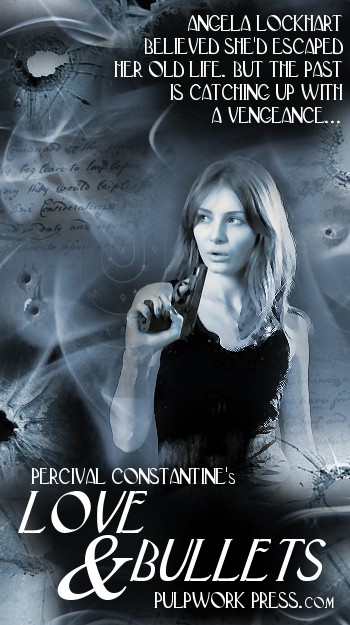
I’ve just completed the first draft of Outlaw Blues. This book is the second novel in the Infernum series, which began with Love & Bullets. Outlaw Blues features an Infernum assassin named Carl Flint, who characters may remember made a very, very minor but very significant appearance in Love & Bullets. (And if you haven’t read the book, what are you waiting for? Head on over to my store and pick up a copy!)

Outlaw Blues follows the Infernum series modus operandi of lots of action, betrayal and intrigue. It does differ a bit–Love & Bullets probably had more in common with John Woo’s Hong Kong Blood Operas such as Hard Boiled mixed with a healthy dose of James Bond trappings. Outlaw Blues is more akin to a modern-day western, taking inspiration from the films of Sergio Leone and Clint Eastwood.

Carl Flint is similar to Angela Lockhart in some respects. He’s an assassin but whereas Angela was out for revenge, Flint is looking for redemption wherever he can find it. And his search will bring him on a collision course with a Colombian drug cartel in a small Mexican town.

Some familiar faces from Love & Bullets will make a reprise, particularly Julie Kim. Readers of Love & Bullets will remember her as the partner of Agency operative Christian Pierce. She was originally written in Love & Bullets as something of a background character, but she proved to be a pretty big hit with readers, which has led to her having an elevated role both in Outlaw Blues and in future installments. And, of course, the colorful and mysterious leader of Infernum, Dante, will return (albeit in a bit of a reduced role).

I’m going to begin edits on the manuscript first thing tomorrow. Depending on the Pulpwork Press release schedule, Outlaw Blues will be available for sale either towards the end of 2011 or in early 2012.

But while you may have to wait a while for the second Infernum novel, you’ve still got other opportunities to read my work. The Myth Hunter is due for an early 2011 release. This will be the start of a new series, featuring a character named Elisa Hill, who travels the world exploring various mythologies. I’m really excited about this new series and Elisa’s a character I’ve been living with for several years now. If you enjoy the Indiana Jones films, chances are you’ll get a real kick out of it.

As far as other future projects, my next novel, which I begun while Outlaw Blues was on hiatus due to computer trouble, is back on track. This book, At The Gates of Hell (working title), will feature paranormal investigator Luther Cross and focus almost exclusively on the realm of Christian mythology. I was thirty pages into it before I was able to resolve the computer trouble with Outlaw Blues, and am now prepared to go full-steam ahead.

And, of course, you can check out SoulQuest, my ongoing online serial at the Revenance Original Fiction site. The second chapter has been sent in and should see a release shortly. I’ve also got some other irons in the fire, but it’s premature at the moment to make any official announcements about those.