The House of the Devil

Where The House of the Devil gets it right, it gets it really right. From the opening credits to the music to the general style of it, if you didn’t know any better, you could easily be fooled into thinking this was a film from the late 70s or early 80s as opposed to 2009.

College student Samantha Hughes (Jocelin Donahue) has found the perfect apartment near campus to get away from her slob of a roommate who’s always having sex with whomever (it’s implied in one brief scene with her that it’s more than one person). The landlady has a good feeling about Samantha and offers to waive the security deposit and just needs the first month’s rent. The problem is Samantha can’t afford it, so she answers an ad for a baby-sitter for the Ulmans (Tom Noonan and Mary Woronov). Mr. Ulman seems a bit strange, but Samantha needs the money and takes the job, against the wishes of her best friend, Megan (Greta Gerwig). When she arrives at the house, Mr. Ulman informs Samantha that he lied and the position isn’t to watch their child, but rather Mrs. Ulman’s mother. Although initially suspicious, Samantha still agrees to stay after Mr. Ulman agrees to pay her four hundred dollars for the night.

As I said at the beginning, when the film gets it right, it really gets it right. Director Ti West proves that he’s an absolute master of the slow-burn suspense-build. Nothing really happens throughout most of the movie, but West does such a great job of slowly building up to things and Donahue is great at conveying her fear and uncertainty at being in this old, large house that I was on the edge of my seat the entire time. This film works perfectly, both as a throwback to classic horror films and as a horror film that can stand on its own.

Unfortunately, when the film reaches the climax, things get a little shaky. As far as direction goes, it’s handled great. Effectively creepy with incredible visuals. But the logic of the characters just makes no sense from what we’ve seen of them up to this point. The villains of this movie are devil-worshippers, I don’t think I’m giving away anything by saying that. But some of the logic they use just seems inconsistent and wonky at best, to the point that I found myself sitting there thinking, “wait a minute…why would they even DO that?” during scenes where I should have been thinking, “ohshitohshitohshitohshit!” Their behavior completely took me out of the flow of the movie and broke the momentum that West had spent all this time building up. And the movie doesn’t hinge on the villains behaving like morons, so with just some rewriting, this could have easily been fixed.

If you’re going to watch this movie, and if you’re a fan of classic horror I recommend you do, then just be warned. Don’t think about the logical holes of the villains, because it will rob you of the scares to be had in the climax.

Ron Fortier reviews THE MYTH HUNTER!

Pulpmaster extraordinaire Ron Fortier has written a great review of The Myth Hunter! Go check it out!

Here’s a bit about Ron had to say about it: “From the opening action sequence to the last climatic battle with a cruel and vicious assassin, ‘The Myth Hunter’ is a super charged thriller that never lets up…a solid, masterful thriller by a young writer realizing his tremendous potential.”

X-Men: First Class Review

I’d be lying if I said I wasn’t dreading this film. Ever since news of it first broke, it seemed 20th Century Fox just didn’t really put the proper effort into planning this. Depending on who in the production you talk to, First Class is either a prequel or a reboot. No one seems to really know. And there are logistical problems in both.

A reboot would be fine—but if you’re going to do a reboot, why not use the five of the original X-Men instead of only one? And if it’s a prequel, then why set it in the 60s, which sets up logical inconsistencies with the existing films? Why not just set it ten years or so before the events of X-Men, with Cyclops, Jean, Storm and Beast as the original team (which is what we’re led to believe was the first class in the original three films).

I’ll get to  more logical inconsistencies later. Suffice it to say, this review will be laden with spoilers! DO NOT READ ANY FURTHER IF YOU DO NOT WANT CRUCIAL PLOT DETAILS REVEALED!

As you’re no doubt aware, X-Men: First Class takes place against the backdrop of the Cuban Missile Crisis. Charles Xavier (James McAvoy) is in Cambridge, using his telepathic powers to guess what drink hot girls want and then hits on them by talking about how their hair color or eye color is an incredible mutation. This is much to the chagrin of his childhood friend, Raven (Jennifer Lawrence), a shapeshifter who he introduces as his sister but who clearly is interested in Charles as something more. Charles, however, has a problem with the fact that Raven’s true form consists of blue skin, bright red hair, yellow eyes and some scaly formations over her naughty bits.

So right off the bat, we’ve got a Charles Xavier who acts like a shallow frat boy. Way to go, Fox.

In another part of Europe, Erik Lehnsherr (Michael Fassbender) is tracking down Nazi war criminals. The primary man on his hit list is Klaus Schmidt, the man who killed his mother and told Erik he was part of a new master race because of his powers of magnetism.

Schmidt however, has a new name these days—Sebastian Shaw (Kevin Bacon). He and his Hellfire Club, which consists of Emma Frost (January Jones), Azazel (Jason Flemyng) and Riptide (Alex Gonzalez) are manipulating the United States and the Soviet Union into inching closer towards all-out nuclear war. The reason behind this is as retarded as can be imagined—Shaw believes nuclear winter will wipe out humanity but will leave mutants in tact. Apparently, now being a mutant means you’re completely immune to a nuclear explosion.

I won’t even get into how this plot is completely contrary to the motivations of the comic version of Shaw, who is simply a power-hungry opportunist. Nor will I get into the bizarre way that they adapted Shaw’s powers into absorbing all kinds of energy and redirecting it as well. It’ll just make me mad. All X-Men fans really need to know about this Shaw is that he’s some sort of bizarre amalgamation of Apocalypse and Bishop.

CIA agent Moira MacTaggert (Rose Byrne, and don’t ask me how Moira went from being a Scottish geneticist to an American secret agent) stumbles upon this plot and witnesses the Hellfire Club’s powers in action. She finds Charles Xavier in record time (recently graduated, he’s apparently already an expert in his field as just a few minutes earlier, he was still working on his thesis) and after reading her mind, Xavier finds out he and Raven aren’t the only mutants out there. Through Moira, they meet the Man in Black (Oliver Platt). It sounds like he should be mysterious, but he’s not. He’s just never given a name. Why couldn’t they have just called him Fred Duncan (maybe only hardcore X-Men fans will recognize that name), since that’s basically who he’s playing?

During an attack on Shaw, Xavier meets Erik and the two join forces. From there, we see them recruit several young mutants to their cause—Alex Summers/Havok (Lucas Till), Hank McCoy/Beast (Nicholas Hoult), Sean Cassidy/Banshee (Caleb Landry Jones), Armando Munoz/Darwin (Edi Gathegi), and Angel Salvadore (Zoe Kravitz).

From there, the film is pretty by the numbers. You have an attack where Darwin is killed off for no reason (just had to kill the token black guy, didn’t you?) and Angel switches sides. Now operating independently, Xavier and Erik train the young mutants in the use of their powers in preparation for the final battle with the Hellfire Club against the backdrop of the Cuban Missile Crisis.

I don’t want it to be said that this film is completely bad. It is far superior to X-Men Origins: Wolverine (and Hugh Jackman makes a cameo in this film which is honestly the greatest part of the movie). I’d say it’s about on par with X-Men: The Last Stand. The direction in First Class is far superior, but the story in The Last Stand is, I’m actually ashamed to admit, better. Mainly because of how completely retarded Shaw’s master plan really is.

Michael Fassbender steals the show as Magneto. He’s got the character down and he’s got the same kind of gravitas that Ian McKellen had. The beginning of the film, when he’s Mr. Nazi Hunter, is awesome. I now want to see Vaughn direct a Cold War Bond film starring Fassbender in the title role. I wouldn’t be surprised if they were both doing this as an audition tape for how they could tackle Bond.

The same can’t really said of McAvoy, who just comes off as a pretentious ass. Hoult gives a decent performance, but completely lacks Beast’s trademark wit and humor. Again, this is a far cry from Kelsey Grammar’s portrayal, who was managed to get across both dry wit and intelligence. In comparison, Hoult is just playing a stereotypical shy geek. Kravitz is gorgeous to look at but has little else going on. Lawrence’s Mystique spends half the movie whining and the other half chasing after almost every guy on the team. Jones and Till have a few good moments as Banshee and Havok and they do serviceable jobs in their roles. But they ultimately have nothing to work with.

Of all the First Class, Darwin is probably the most interesting, and unfortunately, his only purpose is to serve as the sacrificial lamb.

As far as the Hellfire Club goes, I just can’t buy Kevin Bacon as Sebastian Shaw. He doesn’t have the right presence for a character like that and when he’s wearing that helmet like he does through half the movie, he just looks ridiculous. Don’t get me wrong, I think Bacon’s a great actor. But he’s not a right fit for any version of Shaw, let alone one this badly written.

January Jones…oh god, she’s terrible. Easily the worst performance of the film. Her only role is to look good in lingerie (which she does). Great body but what a bad actress. Her diamond form also looks really bad, almost two-dimensional. And as for Flemyng and Gonzalez, they really serve no purpose in this film other than for action scenes.

And the costumes. While fanboys were bitching about the X-Men wearing black leather in the original movies, I was in favor of it. I agreed that putting the X-Men in blue and yellow costumes may look cool in the comics (and even that is somewhat up for debate), but it doesn’t work on film. And First Class proved I was right. The costumes looked garish and absolutely terrible. If they had to go with something that resembled the original costumes, they should have used a pale yellow and black instead of blue. But as it stands, they just look ridiculous. Especially in bright sunlight.

There was also some really wasted potential in the setting. The original point of putting this film in the 60s was supposedly because of the similarities to the Civil Rights Movement. Yet the only real element of the 60s is the Cold War (and Xavier’s forced utterings of the word “groovy,” which just made me cringe).

Again, there are good elements—Vaughn definitely knows what he’s doing behind the camera and there are some decent to outright great performances. But the story is just ridiculous. And it’s obvious Fox didn’t pay much attention to what they’ve done before with these films.

Look, I’m not a continuity nut. It doesn’t bother me that film adaptations of comic books aren’t 100% accurate. I know they’re not and I know they can’t be. And to anyone who points to situations like Sin City, self-contained graphic novels are nowhere near the same as a comic series which has been running monthly for decades, has numerous spin-offs, and has heavy ties to a shared universe that you can’t touch on because of different studios holding different rights. It can’t be accurate, changes have to be made.

But when you start violating the internal continuity and logistics of the film universe you’ve set up, that shows you really just don’t give a shit. And that’s what pisses me off. Even in badly-done movies like Fantastic Four or Ghost Rider, I still got the sense that the filmmakers cared about what they were doing, they just couldn’t do it well. Here, what’s so irritating is that these filmmakers are capable of doing it well, yet they just don’t seem to care.

Here are some examples of the inconsistencies in the X-Men movieverse that First Class causes:

-In X-Men and X2, it’s made very clear that Xavier and Magneto built Cerebro together. In First Class, Beast has Cerebro already built before he even meets Xavier and Magneto.

-In X-Men, Xavier says Scott, Jean and Storm were his first students. They’re not present in First Class.

-In The Last Stand and Wolverine, we see Xavier in the past, played by Patrick Stewart, walking. In First Class, he becomes crippled when he’s much younger.

-In The Last Stand, Xavier and Magneto are seen, played again by Stewart and McKellen, recruiting a young Jean Grey. In First Class, they part ways when they’re much younger.

-In The Last Stand, Moira is portrayed as a Scottish geneticist. In First Class, she’s portrayed as an American secret agent whose memories of the X-Men are wiped clean.

-According to First Class, in the 1960s, Emma Frost is a member of the Hellfire Club. But according to Wolverine, in the 1970s, she’s younger and the sister of Silver Fox.

-In X-Men, Xavier is surprised when Magneto has a helmet that can block his telepathy. Yet in First Class, Xavier clearly knows Magneto stole the helmet from Shaw.

Of course, that’s all assuming this is a prequel, which is what Singer has said. Now if you take this film as a reboot, as other people involved have said, these aren’t problems. But then you have the question of if you’re going to make this a reboot, why are you using obscure characters like Angel Salvadore and Darwin to round out the X-Men instead of using classic characters like Cyclops and Jean?

Again, there are good elements here and it’s not really a bad film. But it just doesn’t work for me. Too many inconsistencies with the established film continuity and a ridiculous story just pulled me right out of it.
ALL PULP spotlights THE MYTH HUNTER!

The fine folks over at All Pulp have taken it upon themselves to help get the word out concerning The Myth Hunter! First up, Tommy Hancock has given four out of five tips of his hat to the book! In his review, he says, “This book is full of vivid descriptions, fantastically crafted narrative, intriguing and engaging dialogue, but its biggest star is the characterization.  Constantine brings each and every character to life, not just with vivid details, but with emotions and passions.  Even the characters we are meant to like leave us feeling a little divided on just how much we like them, and that’s a sign of humanity granted to a written creation, a skill many writers never ever develop.”

Want to read more? Check out the review!

And once you’ve finished reading the review, you get a look at some of my own thoughts when All Pulp puts me in the hot seat for an interview! The questions were really well-crafted, focusing on the way I write heroines, the choices for supporting characters, and my thoughts on the New Pulp movement.

Interested yet? Go check it out here!

Audition by Ryu Murakami

My first introduction to Ryu Murakami came not with his books, but when I saw the film adaptation of Audition. That movie was a massive turning point for me in a lot of ways—it was my introduction to director Takashi Miike and it sparked my interest in both horror movies and Japanese cinema. If I’d never seen that movie, I may have never developed an interest in Japanese cinema that eventually led to me moving to Japan.

Despite the film adaptation enjoying immense popularity in the west, and despite other Murakami novels being translated into English, for reasons that have never been made clear to me, Audition went un-translated for around a decade.

A year ago, I finally found it was translated and put it on my pile of books I’ve yet to read (a pile that never appears to shrink). By the time I read Audition, I had already read another of Murakami’s books, In The Miso Soup, and absolutely loved it. So given my love of the film and my appreciation of Murakami’s work, I was really excited to read this book.

Audition focuses on Aoyama, a documentary producer whose wife had died several years earlier of cancer. When his teenage son, Shige, tells him he should remarry, Aoyama seriously considers it. He talks to his friend Yoshikawa, who works in television and film, and says he wishes he could interview several different women and then choose his ideal one. Yoshikawa suggests having an audition.

Aoyama is immediately infatuated with twenty-four-year-old Asami when he reads her application and essay. A former ballet dancer, Asami suffered a hip injury that forced her to give up her passion. When Aoyama meets her in the audition, it’s difficult for him to keep himself contained. He starts dating Asami and discovers that she suffered a lot of abuse as a child. Asami has a few other dark secrets, however.

If you’ve seen the film, you already know the story. The movie is a very faithful adaptation with only some minor differences. Some scenes take place in different locations compared to the novel and the book also has some additional scenes not included in the film (and the film plays around with the chronology a bit in such a way that it leaves the ending a bit ambiguous—that ambiguity is nowhere in the novel).

For the most part, the movie is not only a faithful adaptation of the novel, but also does a better job of telling the story. This is particularly seen in Asami’s sinister nature and a lot of that is due to actress Eihi Shiina’s amazing ability to switch between vulnerable and innocent to seductively deadly, sometimes at the drop of a hat. The novel doesn’t do as good of a job—in the movie, you know there’s something darkly unsettling about Asami. In the novel, you mostly feel sympathy for her. And the climatic scene is not as nail-bitingly intense as it is in the film (if you haven’t seen the movie, I’m not saying another word about it).

But there are ways in which the novel goes beyond the movie. One of these is in the depiction of Aoyama. For the most part in the film, Aoyama is seen as almost a complete victim. There is some suggestion that he’s not exactly the most moral guy in the film, but Murakami makes it very clear in his book that Aoyama is not necessarily a good guy. You sympathize with him, yes, but the novel makes no secret of the fact that Aoyama has no problem getting sex and even pays for it as well. And he was doing so while his wife was still alive (presumably while she was suffering from cancer). So there’s a sense of vindication with Asami’s actions, even if the event which sets her off is an extreme over-reaction.

Despite this, Murakami does a great job of portraying Aoyama’s love for Asami. You never get the sense that Aoyama might just be using Asami for sex—it’s obvious that he is deeply, passionately in love with her. And it makes the ending all the more sad—for both of the characters.

If you’ve seen the movie, I encourage you to read the book. And if you’ve never experienced either, you should definitely rectify both those.

The Rook, Volume 1 by Barry Reese

Barry Reese is a great writer, and I’ve had the privilege of being well-versed in a lot of his work before he became one of the leaders of the new pulp revolution. And it’s interesting to see how he’s grown as a writer since then.
The Rook features five stories, each of them starring the eponymous vigilante who operates out of Atlanta. Max Davies is a rich man haunted by visions of his deceased father. Possessed of some psychic abilities and armed with a mystic dagger and guns that rarely run out of bullets, Max spends his nights donning a bird-like mask and calling himself the Rook.

This first volume opens with “Lucifer’s Cage,” a great story that sets up the Rook in his new location. We find out that the Rook once operated in the north but fled when people began to suspect he and Max Davies were one and the same. This of course poses a problem in which why wouldn’t that same suspicion arise once the Rook curiously shows up in the exact same city Max has moved to? You may think this is a critique and it partly is and isn’t—Barry addresses this in “The Gasping Death,” at least in a fashion. But that one mention doesn’t satisfy my curiosity and I hope this is dealt with in future Rook tales.

As far as heroes go, the Rook is an interesting blend of both the pulp characters like the Shadow and modern-day comic book heroes like Batman. Although the Rook does adopt a more merciful stance on criminals, he has a history of killing them and his “mercy” isn’t as merciful as you may think. Setting the tales in the 30s also allows Barry a chance to explore history in hindsight, which he does very well. It’s interesting when there are references to historical events, such as mentions of the Nazis and the conflict in Europe or a statement that down in the south, the Civil War was still very much alive in the hearts of the people. And it also gives Barry a chance to utilize some other creations of that era, particularly public domain ones. This leads to one of the best stories in the collection, the previously mentioned “The Gasping Death,” in which the Rook teams up with another pulp hero, the Moon Man. There are also references to numerous other pulp characters, but I’ll allow you the pleasure of discovering those little Easter eggs on your own.

Barry also does something interesting in these stories. In “Lucifer’s Cage,” Max meets Evelyn Gould, a beautiful actress and the two are immediately taken with each other. In the book’s second tale, “Kingdom of Blood,” they’re married and Evelyn is even working as Max’s partner. There are both positive and negative aspects to this and it really depends on your mood. On the one hand, it’s nice to be spared the cliché of the damsel in distress pining for the hero and never noticing the man behind the mask, and I’m glad we don’t have to be subjected to forced gags of Max trying to make up pathetic excuses for why he and the Rook are never in the same place at the same time. And seeing a love interest who not only challenges the hero emotionally but also proves to be if not his equal than at least very capable on her own physically is a nice treat. Evelyn isn’t the type to be tied down to any railroad tracks or thrown off any bridges—she’ll use her own fighting skills before Max even has a chance to save her. And that’s a very good change, especially for the period these stories are set in.

Now for the flipside to that argument. While it is refreshing to see a hero in a married relationship handled in a realistic way, we do skip over a LOT to get them from the point they meet to the point they’re married and working together. These are story collections, however, and it’s just as likely that Barry will write tales set in those eras as well. Same goes for the Rook’s pre-Atlanta adventures, which I find myself really intrigued by. And this is only the first book—Barry recently released volume five of The Rook series at the time I’m writing this review, so maybe he’s already addressed these things.

There is one thing that did bother me, though, although it is minor in the larger scheme. “Abominations” is a tale which features a villain named Warlike Manchu (another cool reference to a famous pulp villain). My issue here is that Warlike Manchu is described as being from a family on the losing side of the Boxer Rebellion, which would make him Chinese. But then later, Warlike Manchu is seen employing ninjas (Japanese warriors) and refers to himself as a “sensei” (an honorific word in Japanese for teacher or doctor). As someone who knows about Asian cultures, particularly Japanese culture, this is something that took me right out of an otherwise very enjoyable story and it’s a mistake that could have been avoided with just a tiny bit of research.

My other complaint has nothing to do with the stories, but has more to do with the format. I understand this is something Barry probably had no control over, but the large size (9.8×7 inches according to Amazon) and the double-column printing is not something I’m a fan of. I felt like the text was a bit tight in those columns and there were some spacing issues with it. I understand Wild Cat Books is trying to emulate the pulp style of old with this printing method, but for someone more accustomed to reading novels, it’s something that annoyed my eye.

Overall, The Rook is a great introduction to this new pulp hero in a classic setting. Barry has created a character who can stand shoulder to shoulder with not only new creations from the modern-day pulp renaissance, but also with the old favorites he’s clearly inspired by.

Buy now at Amazon

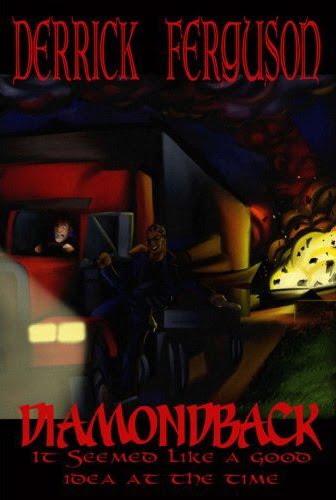
Diamondback: It Seemed Like A Good Idea At The Time

Ever since I read Derrick’s first book, Dillon and the Voice of Odin, I’ve been sold on his work. Derrick has a knack for intriguing characters, snappy dialogue, and some of the best action I’ve had the privilege of reading.
Whereas Derrick’s Dillon series (as of this writing composed of Dillon and the Voice of Odin and the follow-up Dillon and the Legend of the Golden Bell) is a love letter to Doc Savage and the classic adventure story, Diamondback is a true spaghetti western. But like with Dillon, Derrick mixes his love of the classics with a modern sensibility. Derrick has frequently referred to this story as an urban western and that’s the most apt description I can think of.

Although this story could have been set in the Old West out on the frontier, it fits perfectly in the fictional city of Denbrook, which could easily give Gotham a run for its money.

When one of Denbrook’s biggest crime lords is planning to bring in a shipment of hi-tech weapons, it just so happens to coincide with the arrival of gun-for-hire Diamondback Vogel. And this is one mercenary who is the best there is at what he does and what he does is fill his enemies with lead and leave a trail of destruction in his wake. Crime lords, crooked cops, and secret societies are all involved and all interested in Diamondback’s role in this tale. However, Diamondback supposedly died in a shootout in another town, so one of the ongoing questions is just who is this guy? It’s a question that plays no small role in this story and I’m not going to say anything more about that, because you’re better off reading it for yourself.

What I will tell you is this is a great read that won’t suck up a lot of your time. Not only because it’s a short book, but also because Derrick wastes no words. He knows you’re here for the action and he gives it to you in abundance. The action sequences are crafted with both bloody intensity and a flawless grace that would make even John Woo envious. And by the time you reach the last page, you’ll want to track this Ferguson guy down and find out when the sequel is coming, because he leaves you with a cliffhanger ending that will put you on the edge of your seat.

But don’t take my word for it — see for yourself. Diamondback: It Seemed Like A Good Idea At The Time is available on Amazon for $10.95.

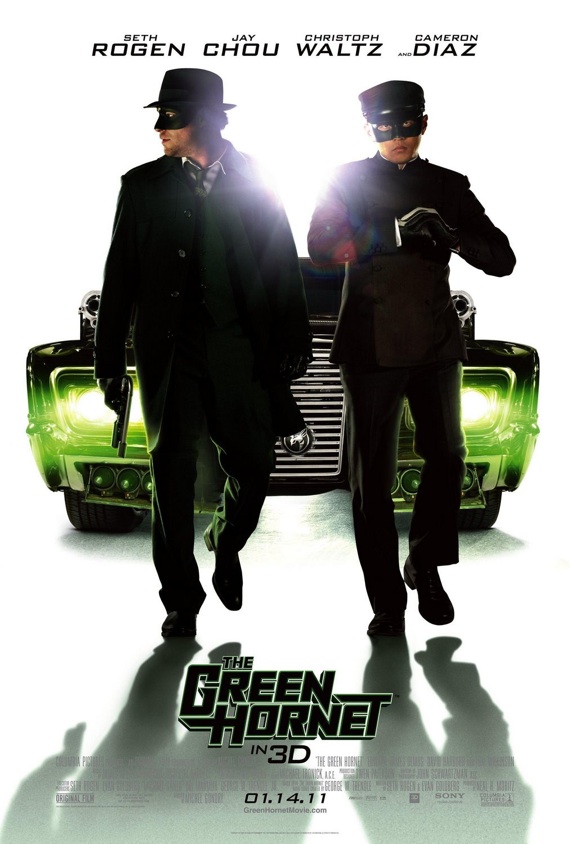
The Green Hornet (2011)

THE GREEN HORNET (2011)

Directed by Michel Gondry
Written by Seth Green and Evan Goldberg
Starring Seth Rogen, Jay Chou, Christoph Waltz and Cameron Diaz

Every so often, there comes a movie that raises the bar. That manages to do something really special and is able to speak to people in a very personal way.

This is not one of those movies.

The film can best be summed up in Seth Rogen’s line to Cameron Diaz at the end, “we don’t know what we’re doing.” Yes Seth, we can see that. We don’t even have to do much thinking to come to that realization. It’s painfully obvious from the first frame of this absolute trainwreck of a movie.

For those who aren’t in the know, the Green Hornet is a pulp hero dating back to the 1930s. Originally created for radio, the Hornet has appeared in comics, film serials, prose and television. The television series from the 60s starring Van Williams is probably the most famous rendition of the character and is particularly notable for introducing the west to martial arts superstar Bruce Lee (who co-starred as Kato).

The Green Hornet is Britt Reid, a newspaper publisher by day and combats crime as vigilante Green Hornet by night. He’s accompanied by his partner and chauffeur, Kato. Thought to be a criminal himself, the Hornet uses this to his advantage to worm his way into the underworld and destroy it from the inside.

This is a great premise for a superhero film and something modern generations haven’t really seen. But somewhere in the long period of this film’s development, someone said, “hey, you know how superhero films like The Dark Knight and Iron Man, which offer serious takes on the characters and show a great amount of respect for the source material, are making a lot of money? How about we do the exact opposite of that?”

In this rendition, Rogen plays Britt Reid, who’s a spoiled brat and a real dick. Presumably because his father, James (Tom Wilkinson) is also a massive dick. In fact, the film goes out of the way to show us how much of a dick James is — our first introduction to him is chastising Britt as a child for getting into a fight with some kids who were bullying a young girl. And then, he takes young Britt’s favorite toy, a superhero, and breaks the head off. That’ll teach the kid to stand up for a defenseless girl!

James dies unexpectedly from an allergic reaction to a bee sting leaving Britt in charge of his newspaper, the Daily Sentinel. Soon after, Britt meets Kato (Chou), James’ personal mechanic who would also invent things for him. And some of the things James made him invent make you wonder if James just wanted to see if Kato was dumb enough to do it. After a few beers, and talking about how much of a dick James Reid was, Britt and Kato decide to do something stupid. They go put on masks and cut off the head of a statue erected in James’ honor. During this, Britt witnesses a crime in progress and tries to stop it. He immediately gets his ass kicked when Kato comes out and with what’s apparently “KatoVision” is able to target the criminals’ weapons and disable them in a split-second. The way Gondry decides to film this, in a slow-motion scene with a zoom-in red outline effect on the weapons makes it look like Kato’s got some sort of targeting vision. In fact, for a second I thought it was the goggles he was wearing.

Because it was “so awesome,” Britt says him and Kato should fight crime every night but make the criminals think they’re the bad guys so they can get inside their operations. Britt instructs the Sentinel to put out stories about a new criminal called the Green Bee (and in a meeting embarrassing his new friend, Kato suggests the Green Hornet instead). With the help of his new secretary, Lenore Case (Diaz), who also just happens to have a degree in criminology, they trick her into telling them what they should do next by having her speculate on what the Hornet’s next move would be.

Kato proceeds to build the Black Beauty, a hi-tech arsenal on wheels while Britt tries on some costumes. On their first night out, and in a show of how little respect this movie has for the source material, Reid plays Gangsta’s Paradise by Coolio and he and Kato start grooving to the music and singing along. Then they stop when they realize they have no idea where to go. When they finally do figure out a destination, heading into the heart of South Central, they approach a Latin gang. Reid addresses one of them by saying, “Hola…I am the Green Hornet. I want to sit down with your boss.” This is followed by the banger putting his gun in the window and the Hornet screams like a little bitch until Kato steps into action.

And that’s basically par for the course. The Hornet cracks painfully unfunny jokes, showcases how completely inept he is, and Kato saves his ass every time. And that doesn’t stop Reid from being a complete and total dick to his supposed friend at every single turn. Just when you think Reid’s character is undergoing some kind of growth, he does something dickish for a cheap laugh (and the laugh never comes because the gag is always terrible). In fact, when Reid and Kato blow up at each other and Kato beats the shit out of Britt, you can’t help but cheer for Kato.

So far I haven’t even mentioned the villain yet, Chudnofsky (Waltz). It should be noted that this is the role Nicolas Cage turned down. That’s right — Nicolas Cage, who has never met a bad role he didn’t like, said “fuck no.” That should give you an inkling of how terrible this film is — Nic Cage turned it down. Chudnofsky is so concerned with appearances, constantly whining about how people aren’t as scared of him as they should be. Because of the Hornet, Chudnofsky decides to start calling himself Bludnofsky and even comes up with a speech to deliver right before he kills someone.

Obviously, if you have even the slightest bit of affection for the Green Hornet, you can see how this is a complete insult to the character’s very long legacy. The only person who is even remotely trying to play this role straight is Chou and I feel really bad for him. Had he been cast in a serious take on the Hornet, he could have made a great Kato.

Do yourself a favor and stay away from this terrible excuse for a film. Instead, stay home and watch a marathon of the 60s TV series.

Dracula Lives!

I’m going to admit something here and now, something which I’m sure my fellow horror fans will probably want to flay me alive for even thinking, let alone giving voice to:

I’m not a fan of Bram Stoker’s Dracula.

I’m not sure what it is, but something about the book just doesn’t appeal to me. I’ve tried reading it a few times and each time I do, I just can’t get into it (although interestingly enough, the other horror classic, Mary Shelley’s Frankenstein, is in my eyes one of the greatest books ever written).

But that’s quite different from the character of Dracula. I love the character of Dracula, I just don’t care much for his first outing. He is, without a doubt, one of the best villains ever created. So popular that even now, over a century after his creation, he still manages to raise hairs on the back of your neck. That’s nothing to scoff at.

One of the best things about Dracula is also one of the worst. Since Bram Stoker’s Dracula is in the public domain, anyone can use one of literature’s greatest villains in their story. The downside to this is that…well, anyone can use one of literature’s greatest villains in their story. This has led to some truly awful renditions of the character (if you’ve seen Dracula 2000 or Blade: Trinity, you know what I’m talking about).

Dracula has transcended the medium of literature. He’s been depicted in film, television, comic books, video games, stage (including a puppet musical in Forgetting Sarah Marshall), and so on. There are some very iconic Dracula renditions, my personal favorite being Christopher Lee’s portrayal in the classic Hammer films.

Of course, this is all just rambling and for that I’m sorry. I’m supposed to be talking about Joshua Reynolds’ latest book, Dracula Lives! And I should devote some time to it, because remember how I mentioned lesser writers who completely abused Dracula’s character?

Josh isn’t one of those guys.

Josh’s Dracula is menacing, imposing, monstrously vicious and savage, but also with a certain charm and elegance. And the amazing thing about Dracula Lives? For the most part, Dracula’s not in it. He remains an imposing figure in the background, and the build-up and tension to his first appearance is handled with masterful subtlety and suspense. By the time Dracula does show his face, you might think it’d be a let-down. But no, not at all — Dracula’s debut in this novel is well-worth the wait.

Of course, you won’t be doing much waiting. The book’s not very long and there’s plenty to keep you entertained up until the titular character stands revealed. Dracula’s been portrayed in gothic romances, slasher flicks, comedies, but it’s not often you see him in a tale of espionage and mystery. And that’s exactly what this is — an espionage thriller, complete with backstabs, shady characters from shady organizations, and some femme fatales for added bonus.

The book centers around an assassin named Jonas Cream. And if you’re like me, you may have chuckled a little when you first read that name. But fortunately, Josh doesn’t give you much time to mock the character and quickly, you’re shown that Cream is the kind of guy you don’t want to mess around with. Unless of course you’re part of one of the shady organizations pulling his strings or trying to kill him.

The thrills never let up, and the veil of mystery over why Cream is so important to these people is handled masterfully. But even better than that, even better than Cream’s development through the book, is the growing menace that casts a shadow over every page. So by the time the last page hits, you are left dumbfounded.

This is only the first of a series of Dracula novels Josh is working on. The second one is titled Dracula Unbound! which if the preview at the end of this book is any indication, hopefully won’t be too far off.

180 pages, available from Pulpwork Press
Buy now at my store!

The Sea Witch

I first discovered Joel Jenkins when I read Dire Planet. This is the first book of Joel’s I’ve read that took place in the real world, so to speak, so it was interesting to see how Joel’s style translates in a non-fantasy setting.

Needless to say, I was not disappointed.

The Sea Witch introduces us to Max Damage, an Olympic fencer and son of Pierre Dommage, a very eccentric man. Growing up, Max was given some very unusual tutoring. Max himself is a bit unusual, extremely strong and fast, a quick healer, but with some drawbacks including sensitivity to light. But Max’s life gets turned upside down when his father passes away and he inherits the family business, Damage Inc. While Max and his new accountant Seth investigate the mysterious projects and messy bookkeeping, they’re confronted by a strange Russian woman named Minnie. It seems Max’s father was involved with a man named Zhinov, President of a splintered Russian state. And now Max and his friends have become Zhinov’s targets.

The Sea Witch opens with a bang and never makes the mistake of letting you get bored. The banter between Max, Minnie and Seth is always fun to read and Joel always manages to find a new way to keep your eyes glued to the page. This is a book that will always surprise you with new action ideas Joel is able to pull out. And the machinations of Zhinov fit in perfectly with his character as a chessmaster. And the mystery behind Max’s unusual abilities as well as his connection to Minnie is maintained nicely through the course of the book until its revelation.

As much as I enjoy Joel’s fantasy work, I have to say The Sea Witch is a welcome change and just might be my favorite of his works to date. I’m looking forward to seeing more of Max and the rest of Damage Inc.

200 pages, available from Pulpwork Press
Buy now from my store!