The Dark Knight Rises

So here we are, the final big superhero movie of the summer (at least if you live outside Japan, but I’ve bitched enough about the four month wait for The Avengers). Not only does The Dark Knight Rises round out the summer trilogy of big superhero movies, but it also rounds out Nolan’s Batman trilogy that began with Batman Begins. When Batman next appears on the big screen, it will be a different actor under the cowl with a different director at the helm, and in a different universe (Warner Bros. has already confirmed they will reboot Batman following The Dark Knight Rises, and I’ll get to that later).

I am a bit sad to see this series end, especially Christian Bale’s role as Bruce Wayne/Batman. Ever since I saw American Psycho, I was telling anyone who’d listen that Bale is the perfect actor to play the Caped Crusader. So when he was actually cast, you can imagine how quickly I flipped. Three movies later, I’m still happy about this choice. There are certain actors who were just born to play certain characters — Christopher Reeve/Superman, Robert Downey Jr./Iron Man, Patrick Stewart/Professor X, and I added Christian Bale/Batman to that list seconds after Batman Begins.

Nolan and Bale brought Batman into the modern superhero cinematic family with Batman Begins and proved that even after the disastrous Batman & Robin, the Caped Crusader can still be a contender. And then Nolan raised the bar for superhero movies everywhere with The Dark Knight. Not only was it a good superhero movie, but The Dark Knight was a game-changer. Now, even the snootiest of film snobs was taking another look at superheroes. And The Dark Knight, in my opinion, didn’t really do anything that hadn’t been done in superhero films before — I think Hulk, X-Men, X2, Iron Man, and Batman Begins all did similar things as well — but the execution of it in The Dark Knight was just better (helped in no small part by Heath Ledger’s stunning performance as the Joker).

But enough on all that. This is supposed to be a review of The Dark Knight Rises so let’s get on that. Spoilers are after the jump.

Continue reading→

The Amazing Spider-Man

Back when it was first announced that Sam Raimi would not be directing Spider-Man 4, you’d think Sony collectively torched the comic collection of every single Spidey fan, because the Internet exploded with rage. Funnily enough, some of the same people coming out of the woodwork to defend Raimi were also raking him over the coals just a few short years ago when Spider-Man 3 came out — damned if you do, damned if you don’t, I guess.

Then came the news that Sony would not continue with the existing franchise — instead, they were going to reboot it and keep the films with Peter Parker in high school. More nerdrage followed. The casting of Andrew Garfield in the title role, again met with hatred and disdain. When the first images of the slight redesign of Spidey’s classic red and blue costume, my god, you couldn’t swing a dead cat without hitting someone who was bitching about how this movie would completely ruin Spider-Man. People even complained about the freaking texture of the suit, saying it looked too much like a basketball and that this meant Spalding must be a sponsor on the movie (which I thought was particularly amusing, because the texture is pretty much identical to the texture of the suit worn by Tobey Maguire in the original films).

Throughout all of this, my comment was the same as it is about every comic book movie that hasn’t even come out yet — you’re being premature. Just wait until you get the chance to actually see the movie before you start hailing it as a harbinger of the end times. It’s something that I’ve found increasingly annoying about the fan culture — particularly comic book fan culture — and it’s why I’ve pretty much backed away from the comic book forums I once frequented (and in one case, even worked for). In the past (and I’m not an old guy, mind you), comic book fans were people who loved comic books. Today, comic book fandom seems composed of people who hate comics, but can’t stop buying them. I don’t get it, because it’s not as if Marvel and DC lace the pages of their comics with opiates (although that would be one way to boost sales — if anyone from Disney or Time-Warner is reading this, I’ve got a patent on opiate-laced comics but a price can be negotiated if you wish to use it).

What was I talking about? Oh yes, The Amazing Spider-Man. Well, I’ve finally gotten the chance to see it (for once, Japan gets a movie slightly early as opposed to getting it a few weeks before it’s due for a DVD release in all other countries — we’ve still got about another month before Avengers comes out here). And I don’t want to say I told you so, but… I freaking told you so!

This movie improves on the Spider-Man franchise in virtually every single way — the only place it falls short is the exclusion of J.  Jonah Jameson (and if they do have Jonah in the inevitable sequel, I hope they get J.K. Simmons to reprise the role, because I doubt anyone else could do it). My major criticism of Tobey Maguire in the first three films is that he made a great Peter Parker, but he could not handle Spider-Man. Maguire is a great actor and he plays the nerdy aspect of Parker extremely well. But when it comes to the sarcasm and the wit of Spidey, Maguire looks like a poor amateur at a stand-up open mic night. Pretty much every joke he attempts to deliver in those movies falls flat on its face.

Garfield, however, completely embodies every aspect of the character. He’s got the teen angst thing going for him, he’s got the shy awkwardness, he’s got the slight selfish streak that Peter’s been known to display, and he’s also got the sharp, witty tongue. When Garfield makes a joke or a witty comeback, it’s actually funny. Cliff Robertson’s Uncle Ben was one of the best things about the first Spider-Man, so that would be a difficult role to top. But when you’ve got the great Martin Sheen, you’re on the right track. I wouldn’t say Sheen is better, because he plays a slightly different Uncle Ben than Robertson. He’s a lot more stern and gruff and it’s a great way to handle it. Sally Field’s Aunt May is also a bit more stern, but we don’t get to see enough of her in this film, so it’s a bit hard to compare her to Rosemary Harris.

The rest of the supporting cast is similarly on-point. Emma Stone’s Gwen Stacy is pitch-perfect casting. I’ve loved Stone ever since I saw her in Easy A. And if there’s one person who can keep up with Garfield’s wit, it’s Stone. The two have wonderful chemistry together. And unlike Kirsten Dunst, who fell into the screeching damsel role in the first three films (and I say screeching because that’s virtually all she did — I do not like Dunst at all, it was the one time when I rooted for the villain to kill the damsel), Stone’s Gwen is actually capable in her own way. She doesn’t play the damsel role, she’s proactive and helps out. Whereas Maguire and Dunst’s interactions were driven by cheesy dialogue and overdone melodrama (try watching those movies again and not cringing whenever these two have a heart to heart), Garfield and Stone feel like real people when they interact. Even when they’re talking about the strange circumstances they find themselves in, they still feel real.

Denis Leary plays her father, Captain Stacy, and Leary is always a joy to watch. And now we come to the bad guy — Rhys Ifans as Curt Connors/the Lizard. He plays both roles perfectly, going between friendly and good-intentioned Connors to the vicious and twisted Lizard. Plus there are definite openings for sequels, which I’ll get to shortly. Even Flash Thompson, played by Chris Zylka, gets more development here than he got in Spider-Man. Whereas in Spider-Man he was just a meathead bully, he gets a little bit more here. After Uncle Ben’s death (that’s not a spoiler, everyone knows Uncle Ben always has to die), Flash has an interaction with Peter in the school and you think it’s going to be another bullying incident — but it turns out not to be. That one scene gives Flash more depth than he had the last time he appeared in this franchise and it hints to the future of the characters in the comics where they eventually become close friends.

The way Spidey moves in this movie reminds me a lot more of the Spidey from the comics. He’s quick and agile and no contortion is too difficult. He’s got very insect-like movements and it’s thrilling, especially on the big screen and in 3D. They’ve also got an interesting way of linking his back-story between the past and present by having his father a former scientist at Oscorp. I thought Oscorp would just be used as a nod to the comics, but we do get a bit more insight into Norman Osborn, although he remains an off-screen presence.

And now, to get into some spoiler territory. Continue on to read the rest.

Continue reading→

The New Scarlet Spider

Ben Reilly as the Scarlet Spider

I was skeptical about this series when it was first announced. You see, as crappy as the Clone Saga was in the 90s, there was one good thing that came out of it — Ben Reilly, clone of Peter Parker who took on his own web-slinging identity as the Scarlet Spider. In a really convoluted story where Ben was revealed to be the original Peter Parker and Peter the clone, Ben ended up becoming Spider-Man. The less said about that story, the better. It was very poorly handled, and you can read all about how editorial and marketing forced the story into being such a massive pile of crap over at the Life of Reilly (a really good and informative read).

Marvel eventually realized they made a mistake with the way the story was handled and as damage control, they said Ben was actually the clone and Peter the real deal, and so Peter became Spider-Man again. Of course, they also decided to do two other things, which I rank as two of the dumbest moves Marvel’s done with Spider-Man. First, they revealed Norman Osborn (the Green Goblin), who had been dead for years and who died in a very good story, was actually alive all this time and manipulating Peter’s life from behind the scenes all this time. The other thing they did was kill off Ben Reilly, a perfectly viable character with endless potential.

The Scarlet Spiders from Avengers: The Initiative

Since then, Marvel has teased numerous times that they were going to bring Ben back to life. There was Spider-Man: The Clone Saga, a limited series that told the original Clone Saga story in the way the writers had intended. There was a story focusing on a character from Ben’s past in the Spider-Man books, and they even reused the Scarlet Spider name in the pages of Avengers: The Initiative for a trio of characters as the Scarlet Spiders (although eventually all but one of them died). Marvel even said Ben was coming back to life and he was going to get his own series out of the deal. I was ecstatic about that one, until I realized what day they announced it on.

Can you guess what day it was?

That’s right, April Fool’s Day. That’s just mean, Marvel.

The really irritating thing about this whole thing is then-Marvel Editor in Chief Joe Quesada went on a tirade numerous times about how he hated the fact that Spider-Man was married to longtime love interest, Mary Jane. Quesada felt that a married Spider-Man was less relatable to the audience (apparently, only single guys read Spidey comics).

The whole “relatable” argument has always struck me as ridiculous, whenever it’s used. One prime example is people claiming Superman is unrelatable because of his powers but Batman is relatable because he doesn’t have powers. Never mind that Superman’s civilian life and the way he grew up is a lot closer to the way the majority of us grew up as opposed to Batman’s upbringing. And never mind that no one can really relate to being a globe-trotting, Nazi-fighting archaeologist in the forties or a suave, British spy with an arsenal of gadgets, yet no one complains about Indiana Jones or James Bond being unrelatable.

Anyway, I digress. The thing that annoyed me about Quesada’s argument is that in Ben, they had that single Spidey character. The solution? Bring Ben back and then have two books — one with Ben as a freewheeling bachelor and one with Peter as a married guy. Problem solved.

Instead, we got a story in which Peter and MJ sacrifice their marriage to Mephisto and have him muck with the timestream in order to save the life of Aunt May (who’s likely about to croak in a few years anyway). Because nothing bad could possibly happen by asking the goddamn devil to mess with the space-time continuum.

The new Scarlet Spider

But recently, we got a new Scarlet Spider in a snazzy new costume. And I thought this is it, Marvel has finally decided to bring Ben Reilly back to life.

Then I found out that no, Marvel hasn’t done that. What they did do was bring back Kaine. He was the first clone of Peter, but was imperfect and went a bit crazy and tried to kill both Peter and Ben on numerous occasions.

Now apparently reformed, Kaine was getting his own series as the Scarlet Spider. This seemed to me like another great disappointment. Once again, Marvel had teased with the prospect of restoring Ben, but stopped just short of doing it. Of all the characters Marvel has resurrected in recent years, Ben has probably been the one most-often requested. And yet, he seems to be the new Bucky (previously the only character Marvel would never resurrect…until they did).

The series, however, seemed intriguing. Chris Yost (one of the writers on the excellent Avengers: Earth’s Mightiest Heroes TV series) was handling the writing duties, so I decided to give it a shot based on his presence alone.

And despite my reservations, this series is really good! Kaine is a much harsher, darker character than Peter or Ben. The way he handles situations is not the same way either of the other guys would. It’s great fun watching him toe the line between hero and villain in this book.

Am I still upset Ben isn’t back as the Scarlet Spider? Yup. But that doesn’t mean I’m not enjoying this take. Yost has got me onboard for the long haul.
Apple TV 3

Last month, I bought an Apple TV 3 primarily because I wanted to digitize my DVD library.

Why do such a thing? Well for starters, my DVD collection is somewhere around 800 discs. And that takes up a lot of space, especially in a Japanese apartment. I don’t have any cases here, I left them all back in Chicago. The discs themselves are arranged in sleeves in drawers, which means finding what you’re looking for is difficult. It also makes just browsing when you don’t have an idea of what to watch absolutely impossible. So while the process of converting the DVDs is a long one (although I’m close to the end), the ease of being able to access all my movies with the touch of a button is extremely convenient.

Why go with Apple TV 3 instead of Roku? I looked into them both, but Apple TV seemed like a better choice for my needs. I like the iTunes synchronization, and I like the option of customizing the metadata and the cover images. The downside is that iTunes only works with a specific media format — mp4 (or m4v as their extension is called).

Overall, Apple TV works great. I can also access Netflix and other web streaming services. I primarily use it for my movies and TV shows, which are not insubstantial. But I do have a few quibbles, mainly about the GUI.

Mac users may remember that Mac used to have this program called Front Row. You could use it for viewing your movie library as well as browsing things like movie trailers. The Apple TV also uses the Front Row format, and what Front Row basically is is you have the right portion of the screen with a list of all the titles and the left portion shows the cover art, description and any other information about the selected title.

Simple and boring

The thing that really boggles my mind about this user interface (UI) is that Apple is capable of coming up with something better. Hell, the ATV3 already has something better. Just look at this:

Now we’re getting somewhere…

Not only is this format much nicer to look at, but it’s also got a lot more choices for customized views. Each row is a different organization. Imagine something like this, with one row being alphabetical listing, another row being recent movies, another where stuff is sorted by rating, by genre, playlists, etc. Plus all the coverart is right there, which makes it a lot cleaner and a lot nicer to sift through, especially if you have a large library.

The problem here is that this format is only on Apple TV’s iTunes Store interface. For computer sharing with your own files, you’re stuck with the Front Row format. I have no idea why Apple would limit this for people, doesn’t make much sense to me.

See, now we’re talking. These two view options are iTunes grid and coverflow options, respectively. Apple has the coverflow option in iTunes and in the iPad, iPhone and iPod devices. So why have they not added it to Apple TV, or added it in a very limited capacity?

Why all this talk about how it looks? Because that’s pretty much my only gripe with the Apple TV. If Apple could put out an updated UI that gives people the option of switching the view (or at least the option to install custom skins), I wouldn’t have the slightest complaint.

Movies linked to my iTunes library play with no problems. I haven’t had any connection issues streaming over my wireless network. The HD movies I have play in perfect HD quality.

But the UI is annoying.

There is the jailbreak option, where you can install software that allows you to change the UI. Unfortunately, the jailbreak for the new Apple TV hasn’t been developed yet, the hackers are still working on it.

Apple, please correct this one, minor problem.

The Avengers

Before I get into the spoilerific spoilers of this review (of which there will be plenty, of spoilers that is), let me tell you some things right up front: yes, The Avengers is the greatest superhero movie ever made. Yes, I have seen The Dark Knight and yes, The Avengers is better. I’ll get to why a little later in the review. So if you’re reading this to get an idea of whether or not you should see this movie, then I’ll save you the spoiler risks—go see it right this goddamn instant.
This is the part of the review where I warn you, those who have not yet seen the movie, that what follows will spoil it for you. So if you do not want to read any spoilers, please stop reading right now before you are spoiled. I’ve now bolded some variation of spoiler several times, so if you are not yet aware that spoilers will follow, you hereby revoke any rights to bitch and moan for having accidentally read spoilers. You have been warned. Many times.

Continue reading→

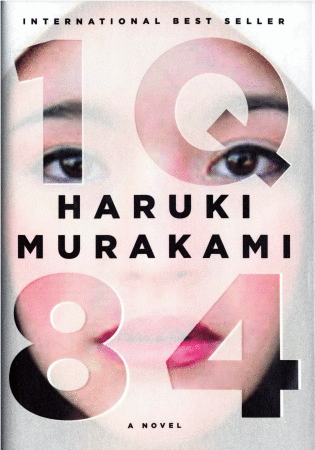
1Q84

A few years ago, I was told that I should read Haruki Murakami’s books. And I started with one that was on sale at my local shop — Kafka on the Shore. I was completely blown away by Murakami’s work. Since then, I’ve read a number of his books — Norwegian Wood, The Wind-Up Bird Chronicle, Sputnik Sweetheart, Hard Boiled Wonderland and the End of the World, and his latest work, which has been called his magnum opus, 1Q84.

The story takes place in the year 1984 and centers on two characters in their thirties. On one side, we have Aomame, a solitary woman with a lonely past who works as a fitness instructor and occasional assassin of men who abuse their wives or girlfriends. On the other, we have Tengo, a solitary man with a lonely past who teaches math three days a week at a cram school and works on his writing in his spare time. At the start of the book, Tengo is reviewing literary submissions for a new writer award and he stumbles upon a fantastic story called Air Chrysalis by a seventeen-year-old girl named Fuka-Eri. He tries to convince his editor, Komatsu, to move it to the top of the pile but while Komatsu likes the story, he doesn’t like the writing style. He comes up with a plan for Tengo to rewrite Fuka-Eri’s novel in secret and Tengo reluctantly agrees after he meets the strange young girl himself. Meanwhile, Aomame is discovering that there are strange events in the world, such as newsworthy events she has no memory of and two moons in the sky. She says she believes she’s in a new world, which she christens 1Q84, the Q standing for a question (in Japanese, this is also a play on the pronunciation, since the Japanese word for nine has the same pronunciation as the letter Q). Aomame is asked by the elderly woman she commits assassinations for to kill the leader of a religious organization called Sakigake, the same organization which the mysterious Fuka-Eri’s parents had once been affiliated with.

I’m going to stop right there with the recap. Suffice to say, the stories of Aomame and Tengo are closely connected. The book alternates chapters between the two of them, until book three when a third character, Ushikawa, is added into the mix. Although some criticized Murakami use of third-person narration (he typically uses first-person), I actually enjoyed that aspect of it. Aomame and Tengo are both two great characters and I really loved their stories.

However, by book three the story really starts to drag. Not a whole lot seems to happen in that section, and I get the feeling that Murakami was just spinning his wheels and trying to pad out the end. The prime example of this is with the character of Ushikawa. When he’s first introduced, it’s obvious he’s a creepy guy who’s not to be trusted. But when Ushikawa becomes one of the major characters in book three, this point is relentlessly hammered into our heads. Every chapter that centers on Ushikawa repeats that he’s ugly and unlikable, as if we’ve forgotten about it since the last time it was mentioned two chapters earlier. While he has some important contributions to the story, we did not need so much of a focus on this guy and Murakami could have excised a lot of useless material from these chapters.

And that’s really the major weakness of the book, what stops it from being truly great. The story just overstays its welcome in book three.

That’s not to say there’s not a lot of good. Even a not-great Murakami novel is better than the best work of lesser authors. But be prepared for some monotony towards the end.

The Adventures of Fortune McCall

Last week, I reviewed the first installment of Pro Se’s Sovereign City Project, The Adventures of Lazarus Gray by Barry Reese. And now, I’ve just tackled the second installment, The Adventures of Fortune McCall by Derrick Ferguson.

If you’re reading this, chances are you’ve already read previous reviews I’ve written of Ferguson’s material. This one won’t be much different. The same witty dialogue and heart-pumping action Ferguson brings to his Dillon stories are present here with Fortune and his gang.

Fortune is a new arrival in Sovereign City, having arrived on his gambling ship, The Heart of Fortune. Also onboard are a loyal crew and an army of soldiers from the Otwani tribe based in the African nation of Khusra. And here’s where things get really interesting.

Despite the urban 1930s setting and Fortune’s gangster-like appearance of a fedora, trench coat and suit, right from the start you can tell there’s something different about Fortune. Namely that he doesn’t speak the way you’d expect a character like this to speak. Although there is occasionally some slang thrown in, for the most part Fortune speaks in a very formal tone and you can picture his speech tinted with an African accent. Turns out, Fortune is royalty in Khusra, but to what extent or why he’s traveling the world, we don’t yet know. We only get the barest hints of this and, just as with Reese’s Lazarus Gray, the mystery of the character’s backstory is the most interesting aspect.

Whereas Reese’s Lazarus Gray tales are more of the supernatural and superheroic variety, Ferguson takes on more of an investigative slant, handling crimes committed by very human people. It’s an important distinction that helps set Fortune McCall apart from Lazarus Gray, but despite that, you still feel like these two characters inhabit the same city. Indeed, just as there were mentions of Fortune McCall in The Adventures of Lazarus Gray, so you also have mentions of Gray in this collection.

The little snippets we’re given of Fortune’s supporting cast are interesting but I feel like the cast itself is a bit too large. For the amount of time there is to tell these stories, there’s not enough space to really go into any of the characters except in a few instances. Names are thrown around a lot and it’s difficult to get a feel for all but a few of them. Tracy is one who stands out immediately, because she’s front and center in most of the stories. Ronald gets some nice spotlight in one of the tales as well. But other than that, it’s difficult to get a feel for them.

Even though it’s difficult to get into some of these characters, when they appear they’re written with great, snappy dialogue, as is Ferguson’s trademark. The stories are quick and punchy and I found myself breezing through each of them in short order.

The second entry for Sovereign City is now in place. I’m looking forward to Tommy Hancock’s installment, featuring the oft-mentioned Doc Daye. But after reading both Reese’s and Ferguson’s takes on Sovereign City, I will say that the bar has been set extremely high. And while I’m confident Hancock will be able to at the very least reach that bar (if not raise it further himself), I will say it’s a task I do not envy. Although other books in the New Pulp movement have had shared continuity, none of them have felt as ambitious as the Sovereign City Project. That makes this a very exciting time for New Pulp fans and I encourage you to get in on the ground floor, if you haven’t already.

Pick up your copy of The Adventures of Fortune McCall at my store now!

The Adventures of Lazarus Gray

Barry Reese is one of the leading figures in the New Pulp movement, and one would be hard-pressed to ask why, given his prolific output and consistently high quality of work. With The Adventures of Lazarus Gray, Reese not only launches into the adventures of a brand-new creation, but he also sets the tone for Pro Se Press’ Sovereign City. And it’s a damn good start.

We’re introduced to the titular hero as an amnesiac who washes up on the shores of Sovereign City. The only key he has to his identity is a medallion around his neck which bares the name Lazarus Gray on the back. Taking this as his name, Gray establishes himself as a force for good in the corrupt Sovereign City, opening up the offices of Assistance Unlimited. His aides include Morgan Watts, a former figure in Sovereign’s underworld; Eun Jiwon, a Korean martial artist with a fiery temper; and Samantha Grace, a socialite with no shortage of fighting skills and intelligence. Together they take on a number of cases in Sovereign City, ranging from simple acts of crime but seeming more often than not to lean towards the supernatural and running afoul of figures from Gray’s previous life as a member of the occult organization known as the Illuminati.

If you’ve read any number of Reese’s work over the past several years, you already know what to expect of him—great characterization, tense action sequences, and entertaining stories. And as usual, Reese delivers. The threats Reese comes up with for Assistance Unlimited and the backstory behind Gray are easily the two most interesting aspects of this collection. My personal favorite choices of villains are Gray’s recurring nemesis, Walther Lunt and the Claw. Some may know that the Claw is actually a public domain character that first appeared in Lev Gleason Publications back in the 30s. If you find some images of him online, he looks somewhat goofy and is pretty much the epitome of everything that was wrong with the “Yellow Peril” craze. But Reese is able to tone that down and instead crafts a Claw who is incredibly threatening and terrifying while avoiding the racial problems that dogged the original incarnation.

The backstory behind the Illuminati is also great. I’m a sucker for stories involving secret societies (or at least I am when they’re well-told), and Reese does a great job of giving us just the barest hints of his version of the Illuminati while still keeping them shrouded in mystery. Particularly interesting is Miya Shimada, Gray’s former lover whom he brought into the society and who seems to have more ambiguity than her fellow Illuminatus, Lunt. The dynamic between them leaves the possibility for future stories really fascinating.

The members of Assistance Unlimited are similarly great, with Eun and Samantha being the standouts in my mind. Both these characters are well-written and extremely capable. Morgan doesn’t make as much of an impact in the early stories, but towards the end of the collection in “The God of Hate,” he starts to take more of a central role and becomes much more interesting.

Surprisingly enough, the character who held the least appeal for me was Gray himself. It’s not because Reese writes a bad character, but it feels at times that Gray is a bit too stoic and a bit too good at his job. Perhaps that’s why I enjoyed “The God of Hate” more than any other story in this collection, because it’s the one where we really get the feeling that the odds are stacked against the hero.

But that aside, the collection is very good and even when things seem like they’re too easy for the hero, the stories never fail to entertain. If you’re a fan of The Rook series, you should definitely check out this collection. Especially since the Rook makes an appearance in one of the tales.

Pick up a copy of The Adventures of Lazarus Gray from my online store!

Four Bullets For Dillon

I’ve made no secret of my affection for Derrick Ferguson’s Dillon series of stories. Ever since I read Dillon and the Voice of Odin, I was hooked. If you’ve never heard the name Dillon before and are wondering just what the hell I’m talking about, I’ll give you some background information: Dillon is the titular character of a number of tales written by Derrick, beginning with Dillon and the Voice of Odin, continuing with Dillon and the Legend of the Golden Bell and the latest installment, Four Bullets For Dillon, features four short stories about the character, stories which are interweaved through the history laid out in the previous two full-length novels.

Dillon is a soldier of fortune. If you’re a fan of Doc Savage, Indiana Jones, Nick Fury, James Bond or any number of similar characters, you’re doing yourself a disservice if you haven’t read any of the Dillon stories. He’s an adventurer in the classic sense, a man of action armed with not only an impressive set of combat skills, but a great deal of intelligence and a cunning wit and sense of humor that brings a nice sense of fun to the stories. If you want to know more about the background of Dillon, Derrick’s made that easy for you by setting up a website that tells you everything you need to know about the character.

“Dillon and the Bad Ass Belt Buckle,” “Dead Beat in La Esca,” “Dillon and the Escape From Tosegio,” and “Dillon and the Judas Chalice” are the four tales that make up the book. I was fortunate enough to read “Dillon and the Bad Ass Belt Buckle” and “Dillon and the Judas Chalice” before, but re-reading them has been an absolute treat.

“Dillon and the Bad Ass Belt Buckle” remains one of my favorite Dillon stories. While on a mission to rescue an award-winning actress, Dillon and his ally, Eli Creed, come across a town run by Kudro Mayoka, the certified Bad Ass of Cheap Prayer — and his certification comes in the form of a belt buckle. Dillon has to challenge Kudro to a race in order to leave with the actress, but during the course, they run across the kidnappers.

“Dead Beat in La Esca” was co-written with Joel Jenkins and features a meeting between Dillon and Joel’s character Sly Gantlet of the Gantlet Brothers series (The Gantlet Brothers’ Greatest Hits and The Nuclear Suitcase). It’s a fun tale involving two very proud guys constantly trying to one-up each other and you could tell both Derrick and Joel must have had a ball writing it together.

“Dillon and the Escape From Tosegio” is interesting in that it began as a story for Frontier Publishing Presents #1, an attempt by Derrick and others associated with Frontier Publishing to put together a quarterly comic anthology. The comic is out of print now, but it’s great of Derrick to include a prose version of the story in this collection. If you’re wondering how Dillon ended up at the Goliath in Dillon and the Voice of Odin or why he’s got so much animosity towards fellow adventurer Awesome Times in Dillon and the Legend of the Golden Bell, you need to check out this tale.

And last but not least, “Dillon and the Judas Chalice.” It’s the longest tale in the book, taking up about 50% of the space (at least according to my Kindle). There are some absolutely thrilling action sequences, particularly the opening with a car chase scene through the streets of Denbrook. The story itself is interesting, with a secret society having melted down Judas Iscariot’s thirty pieces of silver into a chalice that’s been passed down through the centuries. It brings the owner whatever they desire, but with the curse that they must betray their loved ones to receive it.

If you’re asking whether or not you should read Four Bullets For Dillon, my answer is the same as it’s been for all other Dillon tales: abso-freaking-lutely. Derrick doesn’t waste any time with his prose — he’s got a snappy style, an ear for dialogue, an eye on action and he never makes the mistake of boring you. I loaded this book onto my Kindle last night and read it from cover to cover this morning without missing a beat.

You can pick up Four Bullets For Dillon through my online store for $9.95 in print format or the digital version directly from Amazon for $4.99.

YesterYear – A Tale of the Past and Present

In Derrick Ferguson’s introduction, he says that Tommy Hancock knows of Harlan Ellison’s mythical idea factory. And as someone who knows Tommy personally, I can definitely attest to that—the man’s got a million and one ideas, and that’s a low-ball number. Anyone who knows anything at all about the New Pulp Movement knows the name Tommy Hancock. I don’t know if he’s the originator of New Pulp, but to my knowledge he coined the term and I don’t think there’s a person alive who will argue with me when I say no one has done more for the movement than him. Whether it’s his work as the editor in chief of Pro Se Productions, running the All Pulp and New Pulp websites, his great promotional work, or his willingness (and eagerness) to talk to anyone who might have a question about pulp.

Other than hearing his ideas, YesterYear is the first time I’ve actually had a chance to experience Tommy’s writing. As I said before, Tommy’s got a million and one ideas, and they’re all winners. So the expectation I had going into this book was that Tommy’s writing ability would match the high quality of his ideas. Such an expectation started to worry me, because I was afraid that there was no way Tommy could possibly have lived up to the standard I set up in my mind.

I’m happy to admit my fears were unjustified.

Tommy constantly talks about one of the facets of New Pulp being plot-oriented. Some might cringe at this—I know I did at first—thinking it might imply sacrificing character development for plot development. But that’s not what happens in YesterYear. In fact, the characters are probably the best thing about this novel.

YesterYear takes place in the present when J.C. Smithenson, himself a former boy detective, is now a writer and publisher. One day, he finds a mysterious package on his doorstep, a package that holds a leather-bound book. This book contains personal journal entries and newspaper clippings of reporter Ramsey Long, who reported on the heroes of the 30s and 40s. The book details the personal histories (and thus, identities) of a number of heroes from back then. Smithenson wants to publish the journal, but there are other forces who want to see it suppressed.

The book is intercut with excerpts from the journal, showing articles and personal stories of the various heroes. Some of them are pastiches of familiar comic book and pulp characters. Others are 100% original. Each one is extremely interesting and could easily headline a novel of their own (my personal favorites being the Night, G.I. and Mind’s Eye).

Now, with all that being said, I do have a few criticisms. World-building is an important aspect of creating fiction and Tommy definitely does build his world very effectively. But sometimes, this world-building comes at the expense of the story. Some characters who appear one way in the excerpts from Ramsey’s journal later show up in the main story completely different from how they were introduced, with little to no explanation as to how they got that way. I think a few less excerpts and a few more chapters focused on the main story would definitely have helped this. As it is, some of the excerpts, although very entertaining, seem to have very little connection to the main story.

A few people have criticized the use of different fonts to differentiate between journal entries. Personally, I thought this was an effective choice and it reminded me of Mark Z. Danielewski’s House of Leaves. But that praise comes with a caveat. While I applaud Tommy’s decision to vary things up, I feel some of the font choices weren’t as strong and provided more of a distraction. I think some more careful selection would have helped this a lot more. There were also some inconsistencies with typography—one example that popped up a lot was how often quotation marks interchanged between curved and straight. Granted I’m a letterer so I’m more sensitive to typography than most, but it was a distraction for me. Another stylistic choice was the constant capitalization of the words Heroes and Villains. I understand why this was done, but it caused some confusion as one of the characters is called Hero. So every time the word Hero popped up, it caused a bit of confusion whether they were talking about the character or using it as a generic descriptor.

Another distraction was the illustrations. No offense intended to the artist, I’m certainly not capable of drawing anything close to that, but I felt they could have used a bit more detail in terms of rendering and shading. As it is, they appear very flat on the page.

These criticisms are of course minor in the larger scheme and more of a technical nature than anything else. The writing is of high quality and I’m looking forward to more stories featuring the YesterYear characters.

YesterYear can be purchased for $12.00 from my Amazon store.