Lucian: Dark God’s Homecoming

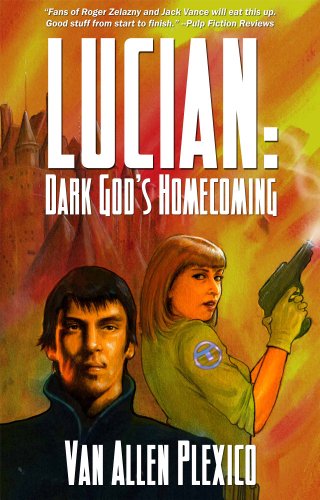
51rgHLDBZOLLucian: Dark God’s Homecoming by Van Allen Plexico

My rating: 4 of 5 stars


I’m a huge fan of Van Allen Plexico’s Sentinels series. Normally I don’t go in for the more space opera-type stuff, so I was curious to see how this book would read. It’s a very enjoyable story with some great action set-pieces. I liked the interaction between Lucian and his human companion, Evelyn. However, I did feel the first-person style was a bit of a weakness from the book. Lucian is a very self-centered character, and while there’s nothing wrong with that, the perspective of the story felt like we got a bit too much of Lucian.


I understand this book is connected to Van’s other space opera books, which I am looking forward to reading. Although I didn’t enjoy Lucian as much as his superhero Sentinels series, it still gave me enough of a taste of this wider universe that I’m interested in discovering more.


Pick up LUCIAN: DARK GOD’S HOMECOMING

View all my Goodreads reviews

Ron Fortier tackles SoulQuest!

Ron Fortier has just posted up a review of SoulQuest at Pulp Fiction Reviews. Here’s a bit of what he had to say:

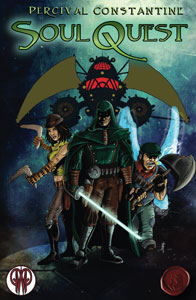
“Soul Quest” reminded me a great deal of those early Ace Paperbacks in which I first discovered science fiction and fantasy as a teenager.  The action never stops; the heroes are true romantic rogues in the classic sense and the villains as dastardly as they come.  For a big book, “Soul Quest” moved at such breakneck speed, I read through it quickly only to be both satisfied and sad to see it end.  Zarim and the crew of the Excalibur are wonderful characters and I really am keeping my fingers crossed we’ll see them again soon.

Thank you for a wonderful review, Ron! If you want to see why Ron’s raving about this book, then what are you waiting for? Go pick up a copy of your own!

SoulQuest

SoulQuest

Author: Percival Constantine
Genres: Adventure, Fantasy, Science Fiction, Steampunk
Tag: Standalone
Publisher: Pulp Corner Press
Publication Year: 2013
Length: 350 pages
ASIN: B00GZ0CF4I
ISBN: 1491262346

In a world of magic and monsters, a ragtag group of pirates, ex-soldiers, mystical beings and creatures of the night must seek out powerful artifacts to prevent a twisted sorcerer from gaining godlike power!

About the Book

In a world where magic and technology exist side by side, Zarim and his crew of sky-pirates live on the fringes of society, stealing what they can and evading the authorities. But a debt of honor compels Zarim to take on the dangerous task of seeking out five mystic artifacts before a sorcerer with power both mystic and political can obtain them. Zarim and his crew must seek out unlikely allies and traverse uncharted territories filled with all manner of strange beings. For if they fail in their quest, control over reality itself will fall into the darkest of hands!

SoulQuest reminded me a great deal of those early Ace Paperbacks in which I first discovered science fiction and fantasy as a teenager. The action never stops; the heroes are true romantic rogues in the classic sense and the villains as dastardly as they come.
Sign up for Updates
Look Inside
Disclosure of Material Connection: Some of the links in the page above are "affiliate links." This means if you click on the link and purchase the item, I will receive an affiliate commission. I am disclosing this in accordance with the Federal Trade Commission's 16 CFR, Part 255: "Guides Concerning the Use of Endorsements and Testimonials in Advertising."

Sentinels: Apocalypse Rising

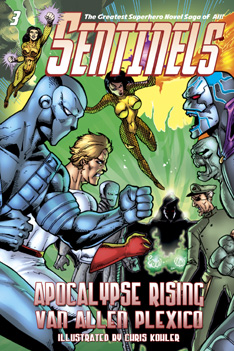
apocalypsemini_2013This is the third book in Van Allen Plexico’s excellent Sentinels series of superhero novels, and the conclusion to The Grand Design trilogy. As a writer moves further and further into a series, some of the magic that was present at the beginning can begin to fade. The characters become overly familiar, the surprises grow less surprising, and there’s a sort of “sameness” that develops.

Although I enjoyed the second book in this series, A Distant Star, there was a sense that it was more set-up for Apocalypse Rising than its own entity. So I was a little worried that Van may not have been able to capture the lightning in a bottle he harnessed so effectively with the inaugural Sentinels novel, When Strikes The Warlord.

Fortunately, my fears were unfounded, because Van certainly brings his A-game to this book. The plot threads that began in When Strikes The Warlord and continued and expanded on in A Distant Star are brought to an awe-inspiring finale that serves as both the end of the first phase in the lives of these characters, and the beginning of something more.

In a world where The Avengers was one of the highest-grossing movies of all time and turned what was once an unknown property to anyone outside of the comic book community, it’s become very frustrating to watch Marvel consistently fumble the ball with their premiere superhero franchise. Of the core titles, one is more concerned with the characters arguing amongst themselves than fighting supervillains, another shows the supposed “heroes” debating the merits of mass genocide in favor of the greater good, and the third features pretentious plot lines and characters who serve little purpose than to act as wallpaper.

It’s extremely disappointing. And that’s why we need people like Van Allen Plexico, who can still give us the same thrilling superhero tales that Joss Whedon and co. delivered so effectively with The Avengers. Van follows in the footsteps of some of the greatest superhero writers in history, names like Roy Thomas, Jim Starlin, Chris Claremont, Kurt Busiek, and Grant Morrison. These men are giants when it comes to superheroes, and Van has proven he is more than capable of standing shoulder to shoulder with them.

If you’re looking for stellar characterization, larger-than-life stories, and, most-importantly, superheroes who aren’t ashamed to act heroic, then you need to be reading Sentinels. Because no one, either in comics or prose, is doing superheroes better than Van Allen Plexico.

Head on over to Amazon right now and pick up your copy either in print or for your Kindle.

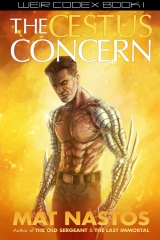
The Cestus Concern (Weir Codex Book 1)

cestusconcernLooking at Mat Nastos’ biography is enough to give you feelings of inadequacy. If you want to talk about making the most of your creative career, he’s definitely one guy who has done that, as an artist for comics/film/TV, director, writer, and now, he can add novelist to that long list of accomplishments. He’s a self-proclaimed Super Genius, and after reading some of his excellent articles on marketing over at his website, I can say that’s a title he’s definitely earned.

The Cestus Concern is Nastos’ first novel, as well as the first book in the Weir Codex series (Book 2 is due out this year). The story centers on Malcolm Weir, a soldier who awakens in an operating room to find cybernetic arms have been grafted to his body and a computer installed in his mind. Fighting his way out, Weir discovers that he has no memory of the past eleven months and seeks to discover what what done to him. With the help of his old college buddy (and conspiracy theorist) David “Zuz” Zuzelo, Weir tries to discover what transpired in the lost year of his life, all while fighting off super-powered mercenaries and assassins dispatched by the government’s mysterious Project: Hardwired, which is also responsible for Weir’s present condition.

The Cestus Concern is some of the best New Pulp out there. Like any good action movie, it’s a roller-coaster ride that grabs hold of you from the first page and doesn’t let go until the last.

I know from my own personal experience that one of the most difficult things to write in a novel is an action scene, because the reader has only your words to visualize it, and sometimes what you see in your head can be difficult to put into words. Nastos has experience with crafting scenes through his work as an artist and director, but being able to translate that into prose is very different. Fortunately, Nastos is able to transition seamlessly into this new medium he finds himself working in, and his action scenes are so vibrant and perfectly and succinctly described that he gives you just enough to let you know what’s happening, but avoids dragging down the narrative with too much description. These scenes move with such speed, that you feel as if you are watching an action movie play out in your head.

Of course, action can only get you so far. You can craft the best action scenes in human history, but it won’t mean a thing unless you’ve got characters for the reader to care about. Fortunately, we’ve got that. Malcolm Weir is a battle-hardened soldier, but when the bullets aren’t flying, he’s a relatable, down-to-earth and funny guy, the kind of guy you could see yourself tossing back a few beers with as you watch a movie or play a video game. We care about Mal as he goes through his predicament, and we feel for him as things go from bad to worse. Also added into the mix is Zuz, who serves a role both as light-hearted comedy relief, but also provides some much-needed narrative explanation. Although there are times when his conspiracy theorist lifestyle borders on providing a bit too much convenience for the story, for the most part he’s an entertaining supporting character that gives our hero someone to play off, rather than being an irritating nuisance like his type of character usually becomes in some of the poorer action fare out there.

Nastos makes no secret of his influences on this book—in fact, he states them in the book’s description: “Fans of films like Bourne Identity or Smoking Aces, or the comics of Deadpool and Wolverine, will love the over-the-top science fiction action of The Cestus Concern.” There are elements of all those in here, and more—it’s an unapologetic hodgepodge of everything you love about over-the-top action movies and comics, and it’s a whole lot of fun to get lost in.

You can pick up The Cestus Concern from Amazon in either print or digital formats. Check out Mat Nastos’ website for more information on not only this book, but his other work.

Django Unchained

django unchainedI know this is coming a bit late. After all, Django Unchained came out in December, it was an Oscar nominee, and it’s generated no shortage of discussion about its themes and language. But I live in Japan, and it was only released in theaters the beginning of March. And given that a theater ticket costs pretty close to $20, not to mention the cost of commuting from my small town to the city, you’re looking at $30 to see the movie. So when a movie is delayed for a Japanese theatrical release until just before it’s available on iTunes to buy for $15, I’ll wait an extra month and get it on iTunes.

Anyway, for those who aren’t aware of the story, bounty hunter King Schultz (Christoph Waltz) buys the freedom of a slave named Django (Jamie Foxx), who is the only lead he has on a bounty. Schultz is German and despises slavery, so he makes Django an offer: if Django identifies Schultz’s bounty, Schultz will give Django his freedom and a portion of the reward.

After it all goes down, it turns out Django and Schultz make a good team and instead of just sending Django on his way to try and reclaim his wife on his own, Schultz makes another offer: work together through the winter, and then together they’ll rescue Django’s wife, Broomhilda (Kerry Washington).

Django agrees and the two become an incredible bounty hunting duo, until they can track down Broomhilda’s new owner, Calvin Candie (Leonardo DiCaprio). Candie, in addition to owning one of the largest cotton plantations in the south (called Candieland), also deals in Mandingo fighting (think a human version of cockfighting or dogfighting). They pose as Mandingo slavers and are able to convince Candie of their legitimacy, but his house slave Steven (Samuel L. Jackson) is not as convinced.

Now, let’s get a few things out of the way right from the start: Django Unchained is not historically accurate. But neither were pretty much any of the spaghetti westerns. Or Mandingo, a film about slaves being forced to fight each other, a film that Tarantino was clearly referencing (I’ve never even seen that movie and I still knew it was a reference). Plus, Tarantino has never claimed to be a historical filmmaker—hell, Inglourious Basterds ended with Jewish-American commandos gunning down Hitler in a movie theater in Paris as opposed to him killing himself in a bunker in Berlin. So as far as historical accuracy, let’s lighten up a bit—no one is going to watch a Tarantino film in order to study for a history test.

Second, there’s the issue of racial language. Yes, the N-word is used quite frequently in this movie. And yes, it is a terrible word. But it seems like its usage is actually handled more gracefully than in other Tarantino movies. Now I know some people will raise eyebrows at that, but bear with me for a moment. Most of the usage of the word comes from white racists, who are either depicted as stupidly buffoonish or completely evil. Django uses it a lot, but Schultz rarely uses it unless he has to in character. Plus, it should be noted that we’re talking about the pre-Civil War era here, so it’s not like the word didn’t exist in this period.

Another concern has been the violence. And again, I say people are making mountains out of molehills. Some reviews have pointed out that some violence is laughed at by white people. What they aren’t realizing is that those scenes are almost always scenes of violence against white racists. Tarantino was actually far more careful with his depiction of violence than in any other movie. In this movie, it’s only the violence against pro-slavery people that’s depicted as funny. Violence against anti-slavery types is depicted as far more gruesome and difficult to watch. Broomhilda’s torture scenes, D’Artagnan’s death, Django hanging upside-down (people who have seen the movie know the scene I’m referring to, I’m being obtuse to not spoil it), these scenes are all depicted not as funny or comical, but as extremely disturbing.

And that was the point. Tarantino attempted to emulate what Takashi Miike did years ago in Ichi the Killer—contrast scenes of playful violence that make the audience laugh with scenes of painful violence that make the audience cringe. The point of these scenes is to make the viewers question the difference between them. If you’re laughing at a scene of horrific violence and are disturbed by another scene of horrific violence, then the question isn’t what’s wrong with the filmmaker, but rather what’s wrong with you.

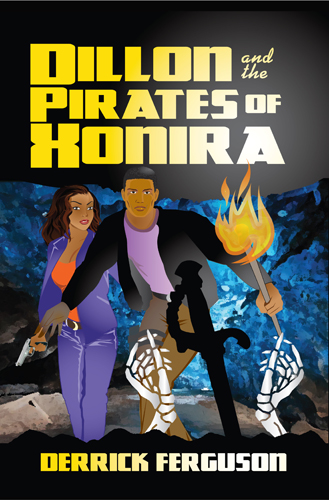
Dillon and the Pirates of Xonira

Dillon and the Pirates of XoniraThey say that the only certainties in life are death and taxes, but I’ve got a third certainty: a Derrick Ferguson Dillon yarn will always be spectacular.

I’m no stranger to Ferguson’s writing or the world of Dillon. I was both fortunate and unfortunate enough to jump onboard when the first book, Dillon and the Voice of Odin, was initially released almost ten years ago. I say fortunate because I’ve gotten to spend that time with this character, reading and in some cases re-reading his adventures. I say unfortunate because that also means I’ve had to endure waiting for the next book to come out. There have been four Dillon books to date: Dillon and the Voice of Odin, Dillon and the Legend of the Golden Bell, Four Bullets For Dillon (a collection of short stories), and now Dillon and the Pirates of Xonira. Each one has been superbly written, with white-knuckle action, snappy dialogue, and witty humor.

This latest tale comes on the heels of The Legend of the Golden Bell, and just like in that book, we see Dillon returning to the fictional nation of Xonira. When I first heard that this book would take place in Xonira again, I have to admit some skepticism on my part—we just finished a tale there, so why did we need to return so soon when Dillon is a global adventurer? But my skepticism was unfounded, as Xonira feels as fresh and as intriguing a setting now as it was a few years back when it was first introduced in The Legend of the Golden Bell.

Dillon, of course, is back. Along with his frequent partner-in-crime and mentor, Eli Creed (who, despite retiring, seems to be doing a very bad job of actually staying retired, and bless him for that as he’s always a fun addition). Signing up for this mission as well is Toi Lahayne, a representative of the mysterious Braithwaite Group and Allie and Shon Pierri, a mother-and-son team of French defense agents. On the other side, we have the Pirates of Xonira, commanded by a man who has some history with Dillon.

The action moves along at a brisk pace. At a little over two hundred pages, it feels like a lot less, given how quickly you can progress through the book. Ferguson very rarely lets up on his characters, even for the briefest of moments, and there’s always something either happening or on the verge of happening (or sometimes both simultaneously).

While the roles of one of the characters seemed a bit too obvious to me at first, Ferguson flipped it on its head slightly at the end of the book. I won’t say anything more about it than that, other than it’s a very realistic thing in this situation, and serves both to give Dillon a bit more humanity by presenting him with a problem he can’t really solve as well as opening the door for a follow-up in the future. And speaking of follow-ups, the last scene hints at exactly that in a very big way.

I’m not sure when the rest of that adventure will be told, but I will be waiting for it.

Sentinels: A Distant Star

I absolutely loved Van Allen Plexico’s first Sentinels book, When Strikes The Warlord. So much, in fact, that once I finished, I immediately bought the second book, A Distant Star. These two books, along with Apocalypse Rising, form the first Sentinels trilogy, “The Grand Design.”

In this volume, we see the return of the Sentinels — Lyn Li/Pulsar, Ultraa, Esro Brachis and Vanadium. We also see the return of the enemy from the first book, the Warlord, albeit in a different form. There are a succession of Warlords, and every time one dies another takes his place, and it’s all part of something known as the Grand Design. Where this leads to is still something of a mystery that I assume will be the focus of the third book.

The Sentinels’ universe also expands with this book, with the introduction of the Kur-Bai, an alien race coming to Earth in order to eliminate the Xorex, a planet-destroying entity that served as the master of Kabaraak from the previous volume. Upon landing on Earth, one of the Kur-Bai, a warrior named Mondrian, and Esro get swept off on an adventure of their own in space, going up against Mondrian’s former shipmate in a Barsoomian setting.

There’s a lot of jumping around in this book as the Sentinels are seemingly pulled apart in all directions. Ultraa is injured, Pulsar has family issues, Vanadium appears to be corrupted, and the government is prepared to cut their support for the Sentinels, especially with Esro missing. All the while, the Warlord is scheming, but it’s really Esro and Mondrian’s story that serve as the most interesting set-pieces here.

Where Plexico succeeds is in his characters, once more. Mondrian is every bit as intriguing and fascinating as the characters introduced in the previous volume. Her interaction with Esro is a joy to read and Esro himself steps up to the plate, becoming a much more central character than he was in the previous book. It could be said that When Strikes The Warlord was more Pulsar’s story and in that case, A Distant Star is definitely Esro’s. There’s a grandness to this book, a sense of a larger universe outside of Earth. I know that there were aliens in the first, but this one feels more like a space opera.

That being said, one of the strengths of A Distant Star, of it feeling like a part of something greater, can also be considered a shortcoming, depending on your point of view. When Strikes The Warlord can easily be viewed as a stand-alone tale, but with A Distant Star, there’s a lot of set-up for Apocalypse Rising and you know there’s something else coming.

Apocalypse Rising is a book I will be reading in the very near future. So far, Plexico has not disappointed with his superhero epic, and I’m looking forward to an epic conclusion of this trilogy!

Sentinels: When Strikes the Warlord

Have you ever had a book you weren’t sure you would like, but then once you started reading it, you couldn’t put it down?

That’s what happened with the first volume of Van Allen Plexico’s Sentinels series. I’ve known this author’s name for a very long time, had it come up many times in the writing circles I run in. But until now, I’d never read anything of his. And despite all the positive reviews about the Sentinels series, I was a bit gunshy.

You see, when it comes to original superheroes, it really is hit or miss with me. When superheroes first appeared. there was some hook to them. Superman was…well, Superman. He was the first, the big one. Batman was an evolution of characters like the Shadow, mixed with the burgeoning superheroes. When we came up to the Marvel heroes of the early 60s like the Fantastic Four, Spider-Man, Hulk, X-Men, etc., they all had these great hooks to set them apart.

But now, it’s 2012. If you’re a fan of superheroes, you’ve got over seventy years of stories to choose from and chances are you’ve read more than a few. So if you’re trying to get people with a new hook, you’ve got a pretty tall order. Most of the times, people think they’ve got a good hook, but it’s really not and the characters aren’t well developed.

Plexico, however, takes a different route. He knows that you know all these stories. He knows that there’s no hook you haven’t heard. And instead of trying to find the next hook, he does what writers of all other mediums do — he makes you care about the characters instead.

And really, that’s all that matters, isn’t it? How many times have you seen the basic hero legend retold over and over? How many times have you see the lone warrior story? If you show someone Yojimbo, A Fistful of Dollars, Brick, and then ask them to read Red Harvest, chances are they will get a very different experience each time, despite the fact that it’s basically the same story. And when it comes to superheroes, I doubt you could come up with a super power that hasn’t already been thought up. But does that matter? Are there many differences between the abilities of James Bond and Ethan Hunt and Jason Bourne? Not really, it’s the characters that make them different.

And it’s the same with superheroes. The Sentinels does not have a unique hook. There aren’t any reality TV shows or hidden conspiracies or trying to overthrow the existing order or anything like that.The Sentinels are superheroes who fight supervillains, pure and simple. But if you’re expecting a cheap, Avengers/Justice League knock-off. you will be pleasantly surprised. Because despite the superficial similarities with popular comic book heroes (and while they’re there, they are very much in passing — I doubt you’ll confuse Ultraa with Superman or Esra with Iron Man), what sets Plexico’s Sentinels apart from the numerous other books is that he focuses on his characters as characters, not as powersets. Even the Cavalier, who is set up from his first appearance as unlikeable, becomes someone you can relate to. And that’s a real testament to Plexico’s characterization skill. Even when Plexico hits the familiar story beats (and I won’t detail what they are because I don’t want to spoil them), there’s a sense of originality because of the great development he’s invested in these characters.

And because of these characters, I could not put this book down. When it comes to books, some take me longer to finish than others. On average, I take about a month or so to finish a book. I finished all 236 pages of this book in a week. Whenever I had some downtime, my first inclination was to read more of Sentinels, and I found myself thinking about it even when I didn’t have the time. It’s rare for a writer to inspire that kind of dedication in a first-time reader.

Needless to say, immediately after I finished this book, I bought the next in the series. And that’s a rare thing for me. Not long before this, I finished The Gunslinger, the first book in Stephen King’s Dark Tower series. But I have not yet bought the second book. Yet I already bought the next Sentinels book.

Van’s got me hooked. Fortunately, I’ve got quite a bit of material to catch up on.
Gunfighter Gothic Volume 0: Blood of the Universe

“Ignore her. She loves to throw all that time travel stuff in our ignorant nineteenth-century faces.”

That quote sums up what I love about Blood of the Universe, Volume 0 of Mark Bousquet’s Gunfighter Gothic series. It’s a snappy piece of writing and more importantly, it tells the readers that this is a world where the bizarre and unexplained is more or less an every day occurrence. Prevailing wisdom seems to be that when you enter a world like the one Bousquet’s created, you need to hold the reader’s hand, explain why all this weird stuff exists, or give you a character who’s more used to the real world.

I’m tired of that. As a reader, I have no problem being thrown into a world with vampires, zombies, werewolves, and time travel. I’ve been around the block a few times, don’t insult my intelligence by making me go through the whole “why do these pale men have such sharp teeth?” thing. 

Fortunately, Bousquet knows better. And he’s given us a tale in a genre that I absolutely love — the supernatural western. Combining these things together makes even the stale conventions of the separate western and supernatural genres feel fresh and new.

A little bit of info on the book’s story: in 1866, Jill is a well-to-do merchant’s daughter who was engaged to be married and ran off. By her side is her family’s servant and her sometime-lover, the Korean-American Hanna. Trying to start a new life, the girls get thrown right into trouble when they came across vampires, werewolves and a time traveling British spy on their train.

And then Bousquet does something really interesting. Jill, who one might assume is the central protagonist? She dies. Writing a book about a duo and killing off one of the partners in the opening pages? That takes balls. At first, I thought I must’ve read it wrong.

Jill’s death drives a large portion of the book, with Hanna now teaming up with two time travellers and an agent of President Grant. All of them are after something called the Universe Cutter, a knife with the power to resurrect the dead.

Hanna is a great character. I’m a sucker for female protagonists, especially in a traditionally male-dominated literary field like westerns and pulp. Not only is she a woman, but she’s a woman of Korean descent, which is great because minorities, particularly Asians, have gotten the real short end of the stick in pulp, dogged by extremely racist stereotypes. Bousquet seems pretty well-aware of this and he avoids any of the traditional clichés — Hanna is not a kung fu master, she’s not a dragon lady, she’s not a math whiz, and most importantly she doesn’t speak “rike dis.” She’s a very capable gunfighter, born and raised in America. Whenever someone comments on her country of origin, she always remarks that she’s American-born. Asian Americans and Asian immigrants weren’t exactly well-regarded during the late 1800s, so it’s definitely an interesting period for a character like Hanna.

Bousquet’s writing pops all throughout. The dialogue is real, even when in these unrealistic situations and the action moves at a brisk pace.

Unfortunately, for all the good in Blood of the Universe, there is a bit of bad — namely the technical aspect. In the Kindle edition, there were more than a few errors throughout, even some parts where Hanna was incorrectly named as Jill (and that was a cause for confusion more than once). These errors mostly amount to a distraction at worse, so don’t let that deter you.

Overall, we’ve got an impressive start to what I hope will be a long-running series.

Ron Fortier Reviews Dragon Kings of the Orient!

Just as he’s reviewed all my other New Pulp offerings, from Love & Bullets to Outlaw Blues, Ron Fortier has now kindly offered his thoughts on the latest installment in the fascinating and bizarre life of myth hunter Elisa Hill.

Here’s just a bit of what Ron had to say:

In this age of the popular urban fantasy genre, we seem to be inundated with more and more series featuring sparkly vampires, sexy witches and zombie private eyes.  Enough for this reader to yell, “Uncle!”  Contantine’s Dragon Kings of the Orient, packs more wall-to-wall action than any of ten of those other wimpy titles combined.  Being an American teacher in Japan, he has a unique, personal perspective on the Far East and its culture and uses it to great advantage in this rousing adventure tale. 
 
In the past, he has offered us other series but none of them can hold a candle to this one. Elisa Hill is a truly original, fun character and I hope we get to read many more of he exploits along with those of her truly remarkable supporting cast.  People, this book is a solid must read!

As always, Ron, thanks for the kind words! You can check out the rest of this review, as well as Ron’s other reviews, at Pulp Fiction Reviews. Once you’ve done that, why not swing on over to Airship 27, Ron’s own New Pulp publisher?

You can find both print and digital copies of Dragon Kings of the Orient available in any number of online booksellers. Check out the Novels link on the menu bar for more information!