Work In Progress

wipI’m still muddling through the middle of SoulQuest. This one section of the book is proving pretty difficult to write for some reason and I’m not really sure why. It could just be some general fatigue with the project as a whole. It’s been a while since I’ve written a longer piece than the novellas I’ve become known for over the past few years.

I’ve got a new piece I sent in to GaijinPot last weekend, which my editor told me would be up soon. So it will probably turn up by the weekend or early next week.

Once I’ve finished SoulQuest, I’ve been contemplating what I should work on next. It’s been a while since I’ve written an Infernum story, and I’ve got one planned for the third book in that series. Going along with the tone I’ve established for that series, it’ll be a stand-alone book featuring a brand new protagonist, with some familiar faces in supporting roles. I can promise that Dante, Tauna, and Johnny Venom will all show up.

Another potential project is the third Myth Hunter book. For those of you who have read it, you know Dragon Kings of the Orient ended on something of a teaser for the next book (and if you haven’t read it yet, what’s stopping you?). The next book will feature Elisa re-teaming with her sometime-friend, sometime-foe Lucas Davalos and going after the…well, read Dragon Kings of the Orient for the tease.

And then there are two other projects I’ve considered, both of them unrelated to anything I’ve done so far. One is a superhero book I’ve considered doing for a while. The other would be set in postwar Japan. But it’s too early to say anything more about either of these just yet.

Of course, it’s a bit too soon to get too invested in other projects while I’m still pounding away at this one. I might switch gears just a bit to do something different, since lately I’ve only managed to knock out a few hundred words per day as opposed to my goal of two thousand. Or I might just keep plugging away until I get back into the groove.

Making The Punisher Work

punisher-bradstreetI want you to think for a moment about how many successful movies and TV shows have featured a veritable one-man army taking the law into his own hands and dealing out harsh justice to some well-deserving bad guys.

Can you think of one? My guess is you probably have difficulty thinking of just one. That’s because Hollywood has a very, very, very long history of telling these types of stories, and why not? They’re straightforward, they don’t have to be expensive, and people seem to really like them.

So why is it then that we’ve now had not one, not two, but three separate movies featuring Frank Castle, the Punisher, and none of them have managed to really get it right? The Punisher should be the easiest comic book character to make a successful movie out of. Yet no one seems to have really been able to do it. And more than that, what can Marvel do to make the Punisher work now that they have the rights back.

First, let’s look at the film that started it all.

punisher-lundgrenThe Punisher (1989)

This film was the first attempt to bring Frank Castle to the big screen. It featured Dolph Lundgren with his hair dyed black. In this movie, Frank Castle is a former police officer whose family is killed in a mob hit. Legally declared dead, Castle now lives in the sewers and wages a one-man war on crime. His former partner (Louis Gossett Jr.) is trying to bring him in. Meanwhile, the mafia is under threat from the Yakuza, who have kidnapped their children and the only one they can turn to is the man who has declared war on them.

In the plus column, Lundgren does a pretty good job as Castle. But the script isn’t too terribly good and there’s some cheeseball parts in here that are real cringe-worthy. Its biggest failing, though, is that if you stumbled on this movie late at night and missed the opening credits, chances are you could go a good long while before realizing it’s a Punisher movie. It’s such a generic action movie and one of the biggest mistakes is they didn’t include the Punisher’s trademark skull shirt. Just including that little detail would have gone a long way to differentiating this from all the other B-flicks flying around at the time.

Because of the studio’s financial difficulties at the time, this didn’t even get a theatrical release in the States and was instead released straight-to-video. It was so poorly received that no one would try again until fifteen years later. That’s when we got…

tomjane-punisherThe Punisher (2004)

When I first saw the movie Thursday, I came away with one thought: the actor who played Casey, a former drug dealer who has gone straight and whose life is thrown upside-down when his old partner comes calling, would make for the perfect Frank Castle. As long as he dyed his hair black.

That actor? Thomas Jane. So you can imagine my excitement when my dream pick ended up being cast in Jonathan Hensleigh’s Punisher reboot. This time around, they stuck a bit closer to the comics, including giving Frank his signature death’s head symbol.

This time around, Castle was ex-military who was working with the FBI. On his last job, the son of money launderer Howard Saint is killed. Saint (John Travolta) is not happy about this and he and his wife order a hit on Castle’s family while he’s at a reunion in Puerto Rico.

The beginning is slow and the family reunion scene is just pointless. This movie really suffers from OSS—Origin Story Syndrome. Once we get past the origin and Castle becomes the Punisher, then it picks up a notch (despite some cheesy moments from Castle’s neighbors).

Jane is absolutely perfect as Castle, but the biggest problem once more is the script. He dropped out of the sequel because he didn’t like the direction it was taking, and so that led to the sequel becoming a reboot, and that brings us to…

MP_PunisherWarZone_DVDFSWS_OCARD.inddPunisher: War Zone (2008)

This time around, Ray Stevenson plays the part of Frank Castle. And it’s also the closest we’ve gotten to a good script and the one that stays closest to the comics.

The Punisher’s origin is told very simply in a quick flashback. Castle is a military guy and he’s back in New York (the previous film being set in Tampa). They even managed to work in a little-known tidbit from the comics—before the military, Frank was studying to become a priest. We’ve also got a better supporting cast in the form of Microchip, played—surprisingly well—by Wayne Knight. And we’ve also got the Punisher’s nemesis from the comics, Billy Russo, Jigsaw (Dominic West).

Stevenson does a good job, but the costume design was really bad. I get they tried to make him look like he’s wearing body armor, but that vest makes it look like he’s wearing a neck brace. And in a lot of scenes, the skull is so faint that it can barely be seen. Costume design aside, though, he’s good. Not as good as Jane, but he gets the job done.

Dominic West, however, is just terrible. Same goes for Jigsaw’s brother, Looney Bin Jim (Doug Hutchison). Right in the middle of this serious movie, director Lexi Alexander dropped in two characters who act like they should be in an R-rated version of the old Batman TV show—yes, they really are that campy. There’s a total disconnect between Stevenson’s serious performance and West’s cartoonish over-the-top debacle.

The tragedy of the latter two Punisher films is that if you took Jane, Travolta, and Will Patton (who played Howard Saint’s right-hand man in 2004’s Punisher) and cast them as the Punisher, Jigsaw, and Looney Bin Jim, then you’d have a really awesome film that I think both the average movie-goer and Punisher fans alike would have been happy with.

So now the question…

Where Do We Go From Here?

That’s actually pretty simple. If you haven’t yet, go watch Dirty Laundry on YouTube. It’s an unauthorized short Punisher film starring Jane as well as Ron Perlman and directed by Phil Joanou. And it is incredible. This is what a Punisher movie should be like—dark, uncompromising, and violent.

But I say, forget the movie route. Three times we’ve tried, now let’s try something different. Marvel is looking to expand into live-action television, starting with ABC’s upcoming SHIELD series. And one of the easiest characters to bring to television is the Punisher…depending on how you bring it to TV. There was, briefly, a Punisher series in development recently, but it looked like bad news from the start.

Now here’s my idea. If you haven’t yet, check out Netflix’s remake of House of Cards, directed by David Fincher and starring Kevin Spacey. It’s a Netflix exclusive series and it is remarkable. Disney recently signed a licensing deal with Netflix. And while the Punisher isn’t a good fit for network TV with all its constraints, there wouldn’t be any such constraints if the show were a Netflix series.

It’s pretty simple, actually—hire Phil Joanou to develop a Punisher series for Netflix and get Tom Jane to star in the title role (I also wouldn’t mind seeing Wayne Knight back as Microchip). Everything’s already set up for it. Jane is very interested in coming back to the role and is very fond of the character, Joanou obviously has an interest as well, or else he wouldn’t have directed Dirty Laundry. Disney now owns Marvel and Marvel Studios recently got back the rights for the Punisher, and now Disney and Netflix have a licensing deal in place.

It’s a great solution all around. You’ll get a live-action Punisher that will enjoy more success and a broader reach than another movie, and it will also help both Marvel and Disney utilize new media.

How to Bring the Justice League to Life

Justice League

Ever since The Avengers proved to not only be a massive financial success, but also a textbook example of how to do a superhero film right, Warner Bros. has been extremely antsy about bringing the DC Universe to cinematic life to compete with Disney and Marvel. But it’s been met with numerous obstacles, the latest reported from Badass Digest that Will Beall’s Darkseid-centered script has been trashed.

Here are some things Warner Bros. needs to do.

1. Get your own Kevin Feige

You know how the Marvel Cinematic Universe has been so successful and integrated together very seamlessly? That’s because you had one go-to guy, and that man is Kevin Feige. If Warner Bros. wants to pull off a successful Justice League franchise, they need to have someone in charge of it who can arrange all the pieces. Christopher Nolan is already the big behind-the-scenes guy on Man of Steel, and you could do a lot worse than bringing him onboard. It’s important that the Justice League movies present a coherent vision.

2. Have a plan

Granted, there weren’t any plans for The Avengers until Iron Man proved so successful, but Marvel quickly got a plan in order once they saw it was viable. Before you could say, “Excelsior!” Marvel had an entire slate of planned films—Iron Man 2, Thor, Captain America: The First Avenger, and topping it all off with The Avengers. When Green Lantern went into production, it seemed like Warner Bros. had some semblance of a plan, but that was quickly undone once the movie flopped. So they went back to the well by allowing Nolan to close the book on his version of Batman, and now they’re trying to find some sort of middle ground with Man of Steel. Yet there’s still no real plan in place.

3. Forget your shame

Watch all the Marvel Cinematic Universe films back to back and you’ll notice something about them—not only are they great movies, but they aren’t ashamed of their roots. Between Smallville, The Dark Knight trilogy, and Arrow, it does seem like Warner Bros. is ashamed of the fact that these characters are comic book superheroes. And you can’t be, not if you want it to succeed. If Joss Whedon didn’t have a lot of affection and respect for the comics he was adapting to the big screen, The Avengers wouldn’t have worked. He didn’t try to run away from or hide the superhero aspect, he openly embraced it. And everyone loved it.

Superheroes are here to stay. Either get over yourselves and embrace it, or stay out of the way.

4. Talk to DC Comics

This is not an option. Expert consultants are nothing new. If you want to make a police procedural, you bring in a police consultant. If you want to make a medical drama, you bring in medical consultants. And if you want to make a good superhero movie, you absolutely must talk to the people who create superhero stories for a living. I know some fans may balk at this given the current state of DC Comics, but there are a number of good creators who work there (and despite my reservations about some of the writers at Marvel, when the studios consulted with those creators, the result was something incredible). And speaking of which…

5. You do still have Bruce Timm and Paul Dini’s phone number, don’t you?

Remember Batman: The Animated Series? Superman: The Animated Series? Justice League? Justice League Unlimited? What did all these shows have in common? Aside from the fact that they were awesome, the answer to that question is Bruce Timm and Paul Dini. If you want to bring the Justice League to the big screen, talk to the guys who successfully brought it to the small one.

6. Hire me

This one is self-serving, but if you want a good Justice League script, drop me a line. I’ll have it to you in a few weeks and I guarantee it will be better (and cheaper) than what you got from Beall. You’ll get a Justice League script that includes the Big Seven (Superman, Batman, Wonder Woman, Green Lantern, The Flash, Aquaman, and Martian Manhunter), it will have an intergalactic threat (either the white Martians or Starro), it’ll have explosions, characterization, superhero showdowns, and a massive climatic battle. So give me a call.

Pulp Ark Ballot now available!

pulp ark logoThe nominations for the Pulp Ark Awards of 2013 have now come to a close. If you sent in your nominations by the deadline, you should have received an e-mail from Tommy Hancock with the final ballot. Make sure you send in your votes! Please note that only those who participated in the nominations are eligible to participate in the final voting. So if you didn’t send in any nominations, you won’t be able to vote. Keep that in mind when the Pulp Ark Award nominations for 2014 roll around in December.

A big congratulations go out to everyone who was nominated. I did quite well this year, and I’ve highlighted my own nominations below. Make sure to take part in the final voting and to mark me down in the following categories! While I’ve been nominated every year for a Pulp Ark Award, I’ve yet to win one, so I hope this year I can buck that trend! But to do that, I’ll need your help!

BEST NOVELLA

Outlaw Blues by Percival Constantine (PulpWork Press)
Dragon Kings of the Orient by Percival Constantine (PulpWork Press)

BEST COLLECTION/ANTHOLOGY

Tales of the Rook by Various (Pro Se Productions)

BEST SHORT STORY

“The Curse of Baron Samedi” by Percival Constantine from Tales of the Rook (Pro Se Productions)

BEST COVER ART

Dragon Kings of the Orient by Percival Constantine (PulpWork Press)

BEST NEW CHARACTER

Carl Flint in Outlaw Blues by Percival Constantine (PulpWork Press)
Sun Wukong in Dragon Kings of the Orient by Percival Constantine (PulpWork Press)

BEST WRITER

Percival Constantine
All in all, I received a grand total of eight nominations this year, including two nominations for Best Novella and two for Best New Character! Pretty exciting all around! And also some stiff competition for the awards this year!

I also wanted to give a nod to everyone else who worked on Tales of the Rook, as well as those who worked on Monster Aces (an anthology which I edited). Plus a special mention to my buddy Curtis Fernlund, who was nominated for Best New Writer! Well-deserved!

My Problems with UltraViolet

ultraviolet_BIGMy first introduction to UltraViolet came through Vudu. Before I picked up my Apple TV, I would often use Vudu to rent digital movies and watch them through my PS3. Once, while searching through new rentals on Vudu’s site, they advertised a program called Disc-to-Digital. I read into it out of curiosity, and here’s what has to be done.

1. Create a Vudu account. Okay, already have one. Also need an UltraViolet account and need the two linked. Umm…okay?

2. Create a movie list of DVDs and/or Blu-rays you want to convert. You can only “convert” movies that UltraViolet has the rights to stream.

3. Take your list and the DVDs you want to convert to your local Wal-Mart. They will mark the disc indicating that it’s been converted (so you can’t loan it to a buddy and have him convert it) and unlock access for the movie through Vudu/UltraViolet.

4. The service costs $2 to “convert” DVDs/Blu-rays and $5 to “upgrade” from SD to HD quality.

So this whole “conversion” thing is not actually a “conversion” at all. I understand paying to upgrade from SD to HD, but paying to get the exact same movie with the exact same quality? This, to me, seems like buying a new DVD player and then having to pay a fee in order to play your DVDs on the new player. For someone like me, who has a collection of around 800 movies, you’re looking at around $1600 in order to have access to the movies I already own.

You’ve got to hand it to the folks behind UltraViolet, Vudu, and Disc-to-Digital: they’re finding creative ways to get you to pay for something you already own with a minimum of work on their part.

Many movies these days come with digital download codes, which is very good. These codes should be included with every movie purchase. But some movies are now locking users into the UltraViolet model, which is very, very bad.

The argument I’m going to make today is similar to the argument I made about ComiXology several months back—if you make obtaining and accessing content legally more difficult than it is to obtain them illegally, people will choose the illegal route. And in this day and age when piracy, especially movie piracy, is a real problem, then the last thing you want to do is to make piracy an attractive option for people.

When I got my first iPod, I didn’t need to pay to put all the CDs I owned onto my computer. I still don’t, I can pop a CD into my optical drive and iTunes will copy it to my computer. But according to the DMCA, I can’t do this with movies. With music, it’s legal. With movies, it’s illegal. And why? Simply because the movie studios were paid up with the right politicians. That’s the only reason.

If I have to jump through hoops in order to convert my library or to get the movie I want on the platform I want, why would I waste all my time with that when I can just head on over to a torrent site and have an HD-quality movie downloaded in a fraction of the time it takes to fill out all these damn forms and registration and verifications and whatnot?

There are a few things studios need to do in order to make things easier for the consumer, and I’m positive the vast majority of consumers will happily play ball and have less reason to complain:

1. If a movie costs the same on Blu-ray as it does on iTunes or Vudu or wherever, it should be the exact same product. That means all the same extras, same quality, everything.

2. Disc releases with digital codes should be redeemable in all formats, not just UltraViolet. I should be able to access all my movies on one device with one account, I shouldn’t need to sell my Apple TV and lose the purchases made there in order to buy an UltraViolet-compatible device.

3. Enough with this DRM and copy protection crap. Backing up your movie collection either on discs or on hard drives should not be illegal. What should be illegal is distributing them. Besides, do some research. You can’t swing a dead cat on the Internet without hitting a site offering DRM circumvention software. Some of it costs money, some of it is free. And, given that movies ripped from DRM-protected DVDs and Blu-rays are still showing up on the torrent sites, it’s plainly obvious that DRM provides zero hindrance to criminals and only serves to frustrate honest customers.

Nothing is going to stop piracy for good. Movie piracy and bootlegs existed long before the Internet. You cannot stop it, you can only take steps to minimize its impact. But the more loops you make the honest customers jump through, the more attractive you make piracy look.

The Muddling Middle

Yesterday, I passed the 25K mark on SoulQuest, so I’ve hit the middle of my 50K goal. Crossing the 50% mark on a project is both exciting and scary and it’s when I enter what I like to call the Muddling Middle.

On every project, when I hit the 50% mark, there are two thoughts that occur to me. The first is, “wow, I’ve made it to the halfway point! This is great, I’m going to finish this thing!” And then the second thought is one of panic: “Wait…I’m only halfway through? All the work I’ve done so far and I basically have to do it all again?”

It’s more of a state of mind than anything else. The majority of my books are novellas of only around 30K, so I’d be close to the end if I were writing those. I entered the Muddling Middle on every one of those books when I reached 15K. When that didn’t happen with SoulQuest, I thought I was in the clear and on a great track…until I hit the Muddling Middle at 25K.

So like I said, it’s a state of mind. It’s even happened on short stories of only a few thousand words. It’s this whole idea of being so close to the finish, yet so far at the same time and also a sense of, “you’ve invested this much into it now, so there’s no turning back.”

And the Muddling Middle can really be the point where a project will either see fruition…or stop dead in its tracks. There have been a number of projects of mine that just stopped dead at the Muddling Middle because I didn’t know where to go. A big part of this had to do with the fact that in the past, I didn’t plan out as much. These days, I do much more planning and I’ve got everything mapped out with SoulQuest—I know where I want to go and what I want to do. I know one theory could be, “well obviously, it’s time to change the plan if you don’t like it,” except I do like the plan and I think it makes for a great story the way everything is connecting together.

So it’s more of a state of mind than anything else. Given how long I’ve lived with SoulQuest and how much effort I’ve put into it this far, I don’t think the Muddling Middle will be strong enough to cause me to drop it. Nonetheless, it’s a difficult stage to hit, and something I’m sure many writers struggle with.

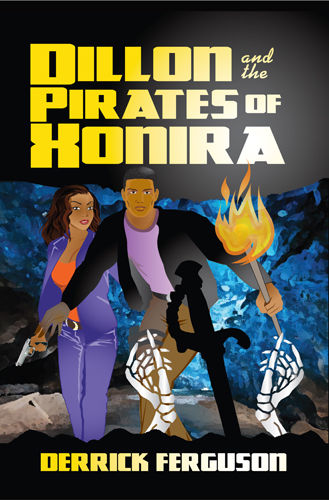
Dillon and the Pirates of Xonira

Dillon and the Pirates of XoniraThey say that the only certainties in life are death and taxes, but I’ve got a third certainty: a Derrick Ferguson Dillon yarn will always be spectacular.

I’m no stranger to Ferguson’s writing or the world of Dillon. I was both fortunate and unfortunate enough to jump onboard when the first book, Dillon and the Voice of Odin, was initially released almost ten years ago. I say fortunate because I’ve gotten to spend that time with this character, reading and in some cases re-reading his adventures. I say unfortunate because that also means I’ve had to endure waiting for the next book to come out. There have been four Dillon books to date: Dillon and the Voice of Odin, Dillon and the Legend of the Golden Bell, Four Bullets For Dillon (a collection of short stories), and now Dillon and the Pirates of Xonira. Each one has been superbly written, with white-knuckle action, snappy dialogue, and witty humor.

This latest tale comes on the heels of The Legend of the Golden Bell, and just like in that book, we see Dillon returning to the fictional nation of Xonira. When I first heard that this book would take place in Xonira again, I have to admit some skepticism on my part—we just finished a tale there, so why did we need to return so soon when Dillon is a global adventurer? But my skepticism was unfounded, as Xonira feels as fresh and as intriguing a setting now as it was a few years back when it was first introduced in The Legend of the Golden Bell.

Dillon, of course, is back. Along with his frequent partner-in-crime and mentor, Eli Creed (who, despite retiring, seems to be doing a very bad job of actually staying retired, and bless him for that as he’s always a fun addition). Signing up for this mission as well is Toi Lahayne, a representative of the mysterious Braithwaite Group and Allie and Shon Pierri, a mother-and-son team of French defense agents. On the other side, we have the Pirates of Xonira, commanded by a man who has some history with Dillon.

The action moves along at a brisk pace. At a little over two hundred pages, it feels like a lot less, given how quickly you can progress through the book. Ferguson very rarely lets up on his characters, even for the briefest of moments, and there’s always something either happening or on the verge of happening (or sometimes both simultaneously).

While the roles of one of the characters seemed a bit too obvious to me at first, Ferguson flipped it on its head slightly at the end of the book. I won’t say anything more about it than that, other than it’s a very realistic thing in this situation, and serves both to give Dillon a bit more humanity by presenting him with a problem he can’t really solve as well as opening the door for a follow-up in the future. And speaking of follow-ups, the last scene hints at exactly that in a very big way.

I’m not sure when the rest of that adventure will be told, but I will be waiting for it.

Have you heard the one about Spider-Man?

So the Internet is all a-buzz right now with the big revelation from Marvel’s Amazing Spider-Man #700, written by Dan Slott. This issue ends Amazing Spider-Man and Superior Spider-Man #1 will be released next month. It’s even earned Slott death threats. Seriously? Grow up, people. I don’t care how bad the story is (and it’s pretty bad), but at the end of the day it’s still just a fucking comic book.

First off, if you plan on buying this issue and haven’t yet, then I’d like to save you some money and time by advising you not to. Seriously, just don’t do it. Especially for the price Marvel is charging (¥700 on my Marvel Comics iPhone app).

Second, if you’re a glutton for punishment and still want to buy the issue, then you should probably stop reading right now. Because otherwise, I will spoil the ending for you.

In other words, spoilers follow, so turn away now.Continue reading→

A decent Superman video game?

manofsteelI frequently have random thoughts.

It will come as no surprise to anyone that I’m a big fan of comic books. I grew up on them. I still read them. The desire to write my favorite comic books is what led to me becoming a writer.

I also grew up on video games and I still play them as well, but I’d be described as a casual gamer at best. I go through gaming spurts and mostly, I’m just out to kill a few hours, so I tend to go for games that more serious gamers might label as unchallenging. The few times I’ve set foot onto Xbox Live or the PSN, my ass has been quickly and embarrassingly handed to me. But, I persevere and play games on lower difficulty settings in my free time and I enjoy them.

Now, being a comic book fan, I keep an eye out for games based on my favorite characters. I’ve enjoyed a good many of them. I know you’ll hear among a lot of gaming circles that there are very few games based on licensed properties that are good. But I’ll be damned if I still didn’t get quite a bit of enjoyment out of them.

Of course there are exceptions. Capcom’s Marvel fighting games, like X-Men: Children of the Atom, X-Men vs. Street Fighter, and the very popular Marvel vs. Capcom series are a lot of fun, but that’s because Capcom basically took their Street Fighter series and replaced their characters with Marvel’s. And Spider-Man on PlayStation was very groundbreaking, because it went a long way in taking what made Spider-Man unique and incorporated that into the game. Then, as everyone is well aware, Arkham Asylum completely broke the mold. For the first time, people had a video game where they could really feel what it was like to be Batman. From using fear and stealth to intimidate your enemies to solving puzzles and just flat-out beating the crap out of criminals, Rocksteady hardly missed a step. There was no way it could be any better, and then Rocksteady topped themselves with Arkham City and gave you the ability to literally glide across Gotham and jump from rooftop to rooftop.

Whenever I play the Arkham games (and these days, it’s almost always Arkham City), I inevitably start thinking about the potential for other superheroes. Apparently, the game adaptation for The Amazing Spider-Man went halfway between being a groundbreaking Spider-Man game and just being a clone of Arkham City. I’m just going on reviews here, which have convinced me to not pay the (at the time of this writing) $49.99 price-tag the PSN is charging for it. But there aren’t many superhero games that really emulate what’s unique about these different characters. What about an Iron Man game where you can upgrade your armor in different ways for different purposes? Stealth armor at the expense of firepower or vice versa for different experiences in gaming.

And this made me remember a Superman game that had some good ideas, but ultimately didn’t quite mesh together—Superman Returns. Loosely based on the movie, when I read about this game, it sounded like something that was really clever. For the first time ever, Superman was literally invulnerable in this game. No matter how hard an opponent hit you, you could not die. So how to make it challenging? Well, you have to be careful how you defeat a foe, because the city of Metropolis has a health bar and the more damage you cause, the more the health bar depletes, so you have to try to be careful with how you take on opponents. But as clever as this is, in the end it’s basically a clever way of convincing you that you’re invulnerable when you’re really not. Because when the city’s health bar depletes, that’s basically like what happens when a character’s health bar depletes.

It is a start, though. The important thing is to look at what Superman can do. You know how in the Arkham games, Batman has his Detective Mode that shows him where all the enemies are? Superman has that as well–it’s called x-ray vision. He’s also got microscopic vision, which can be very effective to detect things other people might mist. And super-hearing. These are powers that are often overlooked, especially in games, but can actually be really useful. Superman’s got a strict ethical code, so although he can just put his fist through Lex Luthor’s head, that’s not an option for him, because he sticks to his code. So instead of fighting Lex Luthor in a suit of armor, what if you have to try and collect evidence to prove that Luthor is involved in a crime? That’d be an interesting alternative and a cool side-quest thing to run alongside fighting enemies. Don’t forget that Clark Kent is an investigative reporter and he’s also got resources with the Daily Planet, so those are things that could be incorporated in a game so it doesn’t just turn into a smash-it-up.

That’s not to say that a Superman game shouldn’t have stages where Superman can bash the hell out of things, but it’s important to find a way to utilize all of Superman’s abilities. Speed, flight, strength, x-ray vision, microscopic vision, heat vision, super-breath, freeze-breath, invulnerability, these are all powers that can be utilized in a clever fashion. Have you seen the recent animated film, Superman vs. The Elite? That’s based on a story titled “What’s So Funny About Truth, Justice & the American Way?” that first appeared in Action Comics #775, written by Joe Kelly. It’s one of my favorite Superman stories, and it contrasts in a wonderful way the difference between Superman’s method of doing things and the methods of more ruthless, grittier superheroes like The Authority.  But one of the clever things that happens is Superman defeats Manchester Black, a man with incredibly powerful telekinetic abilities, not by pummeling him. But rather, he uses his x-ray vision to locate the part of Black’s brain that grants him psychic abilities and then uses his heat vision to harmlessly lobotomize that part of the brain. Black is rendered powerless without ever feeling a thing and without Superman having to throw a punch.

Now that’s a clever use of power, and it’s an example that I hope the makers of the next Superman game will look to. I don’t know if there will be a game based on the upcoming Man of Steel film, but if there is, I hope the designers will pay attention to the things that make Superman Superman and try to give us something that’s unique to Superman. Because no one needs to see another game where Superman just flies around and punches bad guys with some other random powers sprinkled throughout.

The Next Big Thing: SoulQuest

I was tagged in this game by Mark Bousquet earlier this month (which shows you how off my memory can be as I just remembered). The Next Big Thing is a little game where you answer ten interview questions about your upcoming project and then tag five writers in it. For this, I’m going to go ahead and tag Alan Lewis, Jim Beard, Sean Taylor, Kevin Rodgers, and Sean Michael Wilson. Join in if you guys feel so inclined.

TEN INTERVIEW QUESTIONS FOR THE NEXT BIG THING

What is the working title of your book?

SoulQuest.

Where did the idea for this book come from?

Several years ago, I was searching for an artist for a project. I got two responses and one of the artists was very talented, but his style didn’t quite fit the project in question. His style reminded me of the character designs for Final Fantasy VII and Xenogears, two of my favorite video games, and it got me thinking about those games. I then came up with the idea for SoulQuest, and contacted the artist. Unfortunately, the project never came to fruition as a comic book, but the idea has stuck with me over the past several years and I’ve now decided to finally produce it as a novel.

What genre does your book fall under?

Sci-fi/fantasy. It’s very much inspired by Final Fantasy VII and Xenogears, so I wouldn’t go so far as to call it fantasy in the Tolkien sense and there’s enough science and technology in it to set it apart from that setting.

Which actors would you choose to play your characters in a movie?

What, you couldn’t think of a more difficult question? In all seriousness, I’m not really sure. It’s got a fairly large cast. For Zarim, the main character and a sky pirate, I might go with Leonardo DiCaprio. Ekala, his right-hand woman, could only be played by Eliza Dushku. Swul, a hard-drinking, chain-smoking surly faerie would probably be either Jon Polito or Danny DeVito. Tanus, an ex-military guy who gets roped into this would probably be Idris Elba. There are more characters, but it’s difficult to cast them off the top of my head.

What is the one-sentence synopsis of your book?

I’m terrible at writing these things, but here goes: When the power of the ancients is awakened, the fate of the world falls to a ragtag band of pirates.

Will your book be self-published or represented by an agency?

Self-published through PulpWork Press.

How long did it take you to write the first draft of the manuscript?

It’s not finished yet. Currently I’m at around 16,000 words, so got a ways to go. It’s been in development for a while. I first began work on it when it was going to be released digitally as a serialized novel through an original fiction site, but when that site closed down, work stalled. I’ve since come back to it and managed a good bit of progress.

What other books would you compare this story to in your genre?

I’m not sure. I’m not familiar with a lot of books in this style, my inspiration for this comes more from video games and TV/movies.

Who or what inspired you to write this book?

As I said earlier, the impetus that got me thinking was an artist’s particular style and I drew inspiration from the previously-mentioned Final Fantasy VII and Xenogears, as well as TV shows like Firefly.

What else about your book might pique the reader’s interest?

New Pulp has a lot of focus on globe-trotting adventurers, masked heroes, or period pieces. This is a different kind of story from most of the New Pulp, and I hope that will cause some people to give it a look, even if it’s out of curiosity.