Nifty Entertainment

NIFTY2Some of you may have noticed a few changes around here lately. For one, you may have gone to the sales page for Vanguard #1 and been surprised to see that the publisher isn’t PulpWork Press like my work in the past, but rather Percival Constantine/Nifty Entertainment. If you’ve checked my other books, you may have seen that many of them also carry this new tag for the publisher. You may have also seen that the menu for this site now includes a link to Nifty Entertainment.

Mat Nastos, a great writer himself, is the man behind Nifty Entertainment and he proposed a partnership with us. This actually came at a good time for me as I’d been considering parting ways from PulpWork and doing my own thing. It’s not because of anything close to resembling a problem with Joel Jenkins, Derrick Ferguson, Russ Anderson, and Josh Reynolds (the other guys at PWP). I just felt I might have more freedom and maneuverability on my own. Also with my new production and release schedule for 2015, I didn’t want to overload them with all this stuff I’m doing.

What I’m doing with Nifty is more of a cooperative. Everything about my books remains in my control. More than that, Mat and I have very similar ideas about what we believe works and how we’d like to see our readership expand.

So that’s the reason for why Nifty Entertainment is now the name you’ll see under publisher for my books, with the exception of Pro Se, who still publish my Luther Cross series.

It may not seem like a huge development to most, but for me it is and I see a whole lot of potential in this move. I’m more excited about my writing career than probably ever before and a big part of it is because of this change.

Cyber Monday is here!

cybermonday

Black Friday is over, but you can still get some deals today for Cyber Monday!

I’m discounting most of my library to only 99¢ for today only. In addition to books that are already 99¢ (such as Luther Cross: The Reckoning) or free (Love & Bullets), you can also get the following titles for just under a buck!

Note that Barnes & Noble may not have discounted these ebooks yet, so if that’s the case, you can also purchase them from Smashwords.

Books

Nothing Found

What’s wrong with New Pulp?

newpulpI’ve been thinking about this a lot lately. There’s a lot of reason to believe that pulp is alive and well in the mainstream. Seems like every new TV show has pulp elements in it. Superheroes, a total descendent of the mystery men from the pulps, absolutely dominate the box office.

Even with competition from far more visual mediums, pulp still manages to succeed in prose fiction as well. Self-published authors like Russell Blake and JF Penn do very well for themselves writing pulpy action/adventure thrillers, and Mat Nastos’ The Cestus Concern made it to the top of the Amazon charts.

But the rest of the New Pulp books? Not even close to doing that well. I don’t really know of any author who classifies themselves as a New Pulp author who is able to make a full-time living by writing fiction full-time.

I think the biggest problem is a lot of authors working in New Pulp approach it as a hobby as opposed to an occupation. And even those who do approach the physical act of writing with far more vigor than others, there are the other aspects of publishing that they take for granted.

Of course, for those who go through one of the New Pulp publishers, a lot of this is outside their control. Hard to put a link to a mailing list or to other books in the series if you aren’t the one who has final say over the ebook. But even still, one of the things that struck me about the informal New Pulp survey I conducted not too long ago was how few authors have websites they own or mailing lists and the results were shockingly low. Same goes for advertising on book lists, either free or paid. Some websites I’ve seen are a total mess without a listing of titles or buy links.

New Pulp has been kind of behind the curve and there’s no real reason for it. There are things that self-publishing and the Kindle revolution have made possible that are practically tailor-made for pulp. But New Pulp books were some of the last to make the switch over to ebooks. Even now, the majority of New Pulp books don’t include calls to action to pick up the next book in the series, leave a review, or sign up for a mailing list. There’s also the serial format, which has completely passed New Pulp by. I see an awful lot of collections of stories, so why aren’t those stories being released first individually in ebook format and then collected together in a bundle? Why isn’t anyone doing a weekly or monthly pulp serial on Kindle Unlimited?

Of course, this doesn’t apply to everyone in New Pulp. Pro Se Productions’ Single Shot Signatures line is a good example of what more people in New Pulp should be experimenting with. I’m also planning to release at least one serial in 2015, potentially two.

I think the overall thing here is I see a lot of people in New Pulp lamenting that they aren’t selling more books and aren’t getting more exposure. But then when suggestions are made, I see some of those same people then turn around and say, “well what we’re doing is just fine.” Or worse, I see some say, “yeah, we should start doing that,” and then they continue to do the same things they have been doing.

I’m certainly not a best-selling author so maybe I’m not the one to comment on this. But I am trying some new things and here are some words of advice I’d give to other New Pulp authors:

  • Try A Bundle – There are a lot of crossovers in New Pulp. Airship 27 and PulpWork Press recently released The Vril Agenda by Josh Reynolds and Derrick Ferguson. It’s a crossover novel featuring Jim Anthony, Super Detective and Dillon (and the cover should really carry both those logos, plus the subtitle on Amazon should include the characters’ names, but that’s another discussion). To try and drum up some more enthusiasm for this project, I think it would have been a great idea to sell a digital bundle featuring one or two Jim Anthony books and one or two Dillon books for 99¢, advertise the hell out of it, and include a link in the back of the book to The Vril Agenda. Or what about some multi-author bundles? A masked mystery men bundle or a horror bundle or a globe-trotting adventure bundle.
  • Update Your Back-Matter – If you have control over your books and your books are in a series, try to include links to the next book in the series, maybe even with a preview of the next book. Also include links to your website and mailing list. While we’re on that topic…
  • Get a Website and Mailing List – There’s one constant I’ve seen in all successful indie authors—they all have mailing lists. You can set up lists for free at both ReachMail or MailChimp (until you reach a certain number of subscribers), so there’s no reason not to do it. And everyone should really have a website they own. For one, it gives you a lot more control than a free site at Blogspot or WordPress. I use Bluehost with WordPress.org and I use a paid template (but you can certainly find very good free templates). I also use a plugin called MyBookTable, which offers a lot of ways to display my books with tons of buy links. And it’s even free or you can pay for an upgrade to get additional features.
  • Publish Frequently – This is tough if you’re going through one of the New Pulp publishers because you’re restricted to their release schedule. But if you’re self-published, try to plan your releases strategically. I’m doing this right now. My Vanguard serial will contain five books in the first “season” and I’m going to release it monthly. To make sure I can manage this, I’m not offering the first book for pre-order until the fifth book is finished. And yeah, this takes time, but it can be done. I’ve started setting myself a writing goal of 1K Per Day. With that, I can write a 30K novella in a month, or two 15K serials (or three 10K shorts).
  • Experiment – If something’s not working, change it. Sales on my Myth Hunter series haven’t been very good, so I’ve got plans to change things about them—new covers and I plan to finally write the third book in that series, then plan to write more. Never tried a serial? Give it a shot. Never done an ad campaign? Worth a try.

It all comes down to this one important point—no one cares about the pulp revival except pulp fans. And there are two ways to approach this. You can either shrug and say, “well then I’ll just focus on the pulp fans.” I think that’s a poor approach. For one, about half the pulp fans have already dismissed New Pulp just on the general principle that New Pulp wasn’t published during the heyday of the pulps. Two, look at how many New Pulp books are out there, and that number is growing. The existing New Pulp audience is so small that they simply can’t afford all the books that are released.

So I advocate the second way—expand the audience. To do that, you need to work harder at it, you need to invest some money into it, and you need to take it seriously. For those New Pulp writers that view this as just a hobbyist pursuit, hey good for them. This is more directed at those who seriously want to make a living at being a writer. We have to do the work or else it’s not going to happen.

And before anyone says anything, I fully acknowledge that I have not been doing this stuff myself. That’s why I’m changing things.

If you don’t want to do that, then fine, don’t do it. But then don’t go around complaining that you can’t make a living off writing and that nobody is buying or reviewing your books.

Why Reviews Are Valuable

reviewHave you read one of my books?

You have? That’s awesome, thank you.

Have you left a review?

If you haven’t, or if your review is only posted on your own blog, then please do me a favor and go over to Amazon or Goodreads and please post a review of it. There are two reasons why this is crucial:

  1. Most readers will read reviews of a book before they click the buy button. It’s usually a make-or-break situation. If a book has little to no reviews on it, then that reader may not think it’s worth their time. This is the obvious reason why reviews are important, but there’s an even more crucial reason.
  2. There are a lot of book promotion sites out there. People who sign up to these lists to receive book recommendations do so because they trust that the lists will only send them books that are of a decent level of quality. That means these lists have to vet the books and one of the ways they do it is by reviews. If a book does not have a high number of quality reviews and a number of good ratings, the chances of the list advertising that book are far less.

The only way I can grow my business is by having other people help me out. If I’ve sent you a review copy of one of my books, the reason being is because I wanted a review, and whether or not you provide that review will determine whether or not I send you another copy in the future.

Don’t Be Petty

Author Lynn Shepherd recently wrote a blog post for the Huffington Post entitled “If JK Rowling Cares About Writing, She Should Stop Doing It.” A lot of people, myself included, have a lot of problems with this article. Let’s have a look at why:

I didn’t much mind Rowling when she was Pottering about. I’ve never read a word (or seen a minute) so I can’t comment on whether the books were good, bad or indifferent. I did think it a shame that adults were reading them (rather than just reading them to their children, which is another thing altogether), mainly because there’s so many other books out there that are surely more stimulating for grown-up minds.

Okay, let’s stop for a minute. Right off the bat, Shepherd comes off as an elitist snob. “You must read books that are intellectually stimulating. If it’s a children’s book, or if it involves fantasy, then it cannot be intellectually stimulating.” By Shepherd’s own admission, she’s never even read any of the Harry Potter books. Just the very notion that adults would dare to read something that doesn’t fit in Shepherd’s narrow-minded definition of “intellectually stimulating” is enough for her to take issue. Adults should read whatever books they like and the elitists like Shepherd should stay in their ivory towers and leave us common folk to our own devices.

It would have been bad enough had Shepherd just stopped there. But she decided to keep going. Because, you see, if you’re not a big name writer, apparently Rowling is destroying your career. Because Rowling wrote The Casual Vacancy and apparently Shepherd is annoyed that people bought it instead of her books:

It wasn’t just that the hype was drearily excessive, or that (by all accounts) the novel was no masterpiece and yet sold by the hundredweight, it was the way it crowded out everything else, however good, however worthwhile. That book sucked the oxygen from the entire publishing and reading atmosphere. And I chose that analogy quite deliberately, because I think that sort of monopoly can make it next to impossible for anything else to survive, let alone thrive. Publishing a book is hard enough at the best of times, especially in an industry already far too fixated with Big Names and Sure Things, but what can an ordinary author do, up against such a Golgomath?

This line of thinking is, of course, patently ridiculous. What Shepherd is essentially doing is blaming her lack of success on Rowling’s success. Where I come from, we have a word for this: it’s called petty-minded jealousy. Not to mention a lack of personal responsibility.

But Shepherd decided to then go further:

So this is my plea to JK Rowling. Remember what it was like when The Cuckoo’s Callinghad only sold a few boxes and think about those of us who are stuck there, because we can’t wave a wand and turn our books into overnight bestsellers merely by saying the magic word. By all means keep writing for kids, or for your personal pleasure – I would never deny anyone that – but when it comes to the adult market you’ve had your turn. Enjoy your vast fortune and the good you’re doing with it, luxuriate in the love of your legions of fans, and good luck to you on both counts. But it’s time to give other writers, and other writing, room to breathe.

If I were Rowling, my response to this would be, “who the hell do you think you are, lady?” What gives Shepherd the right? And more than that, her arrogance knows no bounds—she’s not standing up for all writers who might be affected by Rowling’s success (which is total nonsense but I’ll get to that in a minute), she’s only standing up for her. Look at what she says: “By all means keep writing for kids.” Or in other words, “you can take away sales from other writers, just not me.”

Now, as to why this whole notion is nonsense. It’s been said that a rising tide lifts all boats. And in reality, Shepherd should be thanking, not condemning, Rowling. Because fans of the Harry Potter series may not have ever tried reading books like The Casual Vacancy or The Cuckoo’s Calling. But thanks to Rowling, now they very well might. And if they like what they read, they might seek out other books in those genres. Perhaps books like the ones written by Lynn Shepherd.

Well…that might have happened. Had Shepherd not seen fit to publicly order Rowling to stay out of her territory as if the publishing world was akin to gangland turf (although that might be kind of fun if it were).

I’m by no means a successful author. Even in the world of New Pulp, I’m not as successful as the likes of Barry Reese, Bobby Nash, Derrick Ferguson, Van Allen Plexico, or others. But do you know what I’ve never done? I’ve never said, either publicly or privately, that the reason my books don’t sell is because of these other New Pulp writers. It’s flat-out idiotic.

Self-Publishers: Hold Yourselves to a Higher Standard

Last month, Chuck Wendig posted an entry on his terribleminds blog, entitled Self-Publishing Is Not The Minor Leagues. Like a lot of Chuck’s posts, it’s a great read. I’m just going to quote a small portion of it, because you should read the whole thing:

The attitude that pervades self-publishing is that it’s a good place to test your craft, to hone your work. We are reminded constantly that the cream floats to the top, that all the crappy self-publishing efforts have no effect on anything or anybody ever despite evidence to the contrary. The culture forgives and sometimes congratulates even the most meager of efforts because of how courageous someone is to take the plunge to publish their own work. The culture says, “Just click publish!” The culture criticizes the faults of traditional-publishing, but excuses (or celebrates) its own. And yet, sometime in the same breath, self-publishing gets painted as a path to traditional publishing, not as a path separate and scenic all its own.

The culture is full of contradictions.

One of the things that he talks about is that self-publishers should be more critical. The basic gist of it is this: if you think your writing is good enough to complete with traditional publishing, then you should make sure that it is presented as professionally as traditionally-published books.

That means revising. That means proofreading. That means editing (and that means getting someone else to edit it as well). That means formatting it properly. That means either designing a professional cover or hiring someone to do it for you.

Now to me, that all sounds pretty non-controversial, right?

Well apparently, I was wrong. Because it has set off a firebomb in the self-publishing community. The entry generated 217 comments, and not all of them were agreeing with Chuck. Over at kboards, there was a lot of pissing and moaning about it, so much that Chuck posted a follow-up. Then there was another post. And another.

You can read some of the comments from people who vehemently disagree with Chuck. As usual when someone suggests a bit more self-criticism, there have been cries and shouts of, “YOU’RE TRAMPLING ON OUR FREEDOM!” One person said that mediocrity and half-assed books should be celebrated and then, in the same post, said that no one is suggesting that self-published books shouldn’t be the best they can be.

joker-not-sure-if-serious

Yeah, I know. I was confused, too.

Here is a fact about self-publishing: it has a terrible reputation. Fairly recently I had a conversation with someone who said that if it’s not good enough to be accepted by a publisher, it’s not good enough to be published, period. Yes, that is a very ignorant way of thinking, but it’s also, unfortunately, not uncommon.

And this race-to-the-bottom, anything goes, “it’s okay if your book looks like shit” mentality does not help. It only encourages the thinking among the general public that self-publishing is a toilet. The fact that a site like Lousy Book Covers even exists is not encouraging.

Is it true that all self-published books are crap that no self-respecting publisher would ever touch? Absolutely not. Is it true that all traditionally-published books are staggering works of brilliance? Hell no. There are both self-published books that are far superior to traditionally-published books, and there are both self-published and traditionally-published books I wouldn’t deem good enough to throw in my fireplace (if I had a fireplace).

If you want to be taken seriously as a professional writer, then you need to start approaching your work with the mindset of a professional.

I’ve seen some retorts to this. Like “well people can browse free samples on Amazon and then they’ll know if a book is worth their time.” Say you need five pages before you decide whether or not a book is worth your money. So you read five pages of one book. It’s poorly edited (if edited at all), there are grammar and spelling mistakes that would cause your high school English teacher to smash the blackboard, and the formatting is sloppy. So you then go to another book. Same problem. And another. And another. Say you go through the first five pages of ten books and they’re all terrible. That’s fifty pages you’ve just read. Would you keep going or would you stop and jump over to the best-seller lists?

This isn’t just speculation—this is stuff I’ve heard from readers. There are a great many people who have sworn off self-published books because of problems like this.

Yes, you learn things over the course of a writing career. Yes, your first book will be much different from your tenth book, because you’ve learned a lot over that time. You learn more about characterization and description. You learn more about pacing and plotting. You learn more about marketing. But one thing you should not be learning as you go is, “wow, I guess Comic Sans is not a good font choice for a cover.” One thing you should not be learning as you go is, “huh, maybe it would have been a good idea to revise this before I published it.”

Here’s a little test you can do: go to your local bookstore or library and find a traditionally-published book that you think is terrible. Look at the cover. Flip through the pages. Regardless of the quality of the story, do you know what you will not find? You will not find an abundance of grammatical and spelling errors. You will not find poor formatting. You will not find Comic Sans anywhere on the cover. Regardless of the story inside, the product has a professional standard. That’s what I’m talking about—hold your book to that same standard.

Self-publishing is easier than ever. You could drink an entire bottle of tequila, bang out a few thousand words on your computer, and then upload the file to KDP without even looking twice at it. You could also spend your entire weekend sitting in your own feces because you don’t want to get up from the couch while binge-watching Breaking Bad on Netflix.

Or in other words, just because you can do something doesn’t mean you should do it.

The point of turning off your internal editor when writing your first draft is so you can just get it out there. But once that draft is finished, you have to turn that internal editor back on and let him go ape-shit on your manuscript. Then you should revise it and hand it over to someone else. And you should format it to a professional standard, regardless of if it’s an ebook or a print book. And then you should design a professionally-looking cover.

And yes, if you cannot do this, then you may have to pay someone. Don’t give me that crap about how “it’s too hard” or “I can’t afford it”—either buckle down and do the work, or save up until you can afford it.

There is no excuse for shoddy products. Self-publishing is great, it’s opened a lot of doors for me that would have otherwise remained closed. If you want your work to be taken seriously, then you have to take it seriously yourself. If you want to be treated like a professional, then act like a professional.

If that’s too much to ask, then please go somewhere else. Because you’re only hurting the rest of us.


EDIT: This post has recently gotten some new traffic. And since I’ve already had to deal with one person who evidently thought it would be more fun to simply skim the post and then call me to task for things I never even said (all while ironically badmouthing me for making false assumptions), I’m going to lay a new ground rule: comments are moderated. I don’t put up with any bullshit here. If you’re not going to play nice, then your comments will be marked as spam. Simple as that.

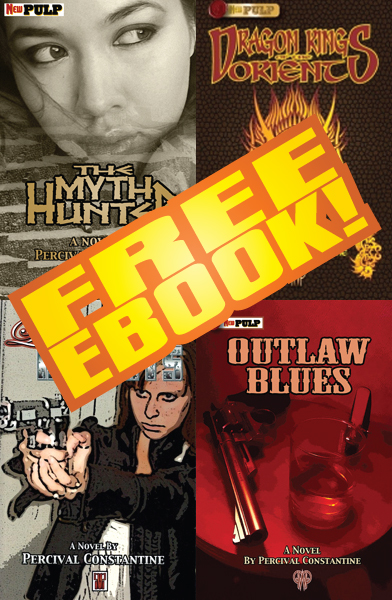
Write a Review, Get a Free eBook!

free-ebookWould you like a free ebook?

Have you picked up a copy of my epic fantasy novel, SoulQuest?

If the answer to both of those questions is yes, then I’d like to ask if you’d be kind enough to post a review of the book, either on Amazon or Goodreads. And to express my appreciation, you’ll receive a free ebook of your choice!

Once you’ve posted your Amazon or Goodreads review, copy the link and then please click here, take a look at the available books, and then fill out the form at the bottom of the page. When I receive the form, I’ll send you your free ebook within a few days!

Thanks for your support!

99¢ Pulp! New Year’s Sale!

99cent

Yesterday, I announced a Kindle Countdown sale where my latest book, SoulQuest was available from Amazon for only 99¢!

But why stop there? Instead, I’m having a huge sale to ring in the New Year!

Until January 5th, you can get SoulQuest from Amazon for 99¢, but you can also get the following books for the same price!

Chasing The Dragon, Love & Bullets, Outlaw Blues, The Myth Hunter, and Dragon Kings of the Orient are all available for 99¢ as well, and will remain that way throughout the month of January!

Head on over to the individual pages linked above, where you can find buy links for your e-reader of choice! Note that some venues may take longer to show the change than others, in which case you can go to my Smashwords page to get them in whatever format you choose!

Here’s to a very pulpy 2014!

GaijinPot

new_gp_1Today, I wanted to take some time to talk a little about GaijinPot. Now, I’m going to be straight with you—GaijinPot does advertise on my site. But I wouldn’t accept advertising dollars for anything I don’t personally find useful. I’ve written several pieces about living in Japan for GaijinPot, but recently they’ve made some changes to their site.

First off, if you’re looking for work in Japan, particularly if you’re looking for work in some of the more populated areas, GaijinPot is a great site to check out. My current job teaching English in elementary schools was obtained through GaijinPot’s website. I was able to craft my resume on their site and then save it, and with a click of a button, I could submit it to any number of employers I found. Fortunately, I was also able to find a job close to the area I currently live in, which was very important to me as I didn’t want to relocate somewhere far away.

GaijinPot’s job search forum has been standard for a while, however. They’ve recently expanded to other areas, where you can find information about travel in Japan and listings for hotels or information about studying in Japan, including information about language schools throughout the country. They’ve also got a section for apartment hunting, and they’ve also got a new podcast called the GPod, hosted by Anthony Joh, which I’ve found to be very entertaining.

If you’re in Japan, or if you’d like to come out here, GaijinPot should really be your first stop.

An Update

So where have I been lately? Around. If you’ve been following me on Facebook, Google Plus, or Twitter, you can see that I’ve started writing for WhatCulture. It’s pretty much all about movies and comics, which has been a whole lot of fun to write about. I enjoy the work I do for JapanTourist and GaijinPot, but when it comes to movies and comics, I just have a whole lot more to say than I do about Japan.

Since I started writing for WhatCulture, I’ve produced a total of ten articles, and I have one more that’s currently under review. I’ve accrued over 200,000 hits total in that month, which I hope will lead to more people following the link to my site and check out my books.

If you’re interested in seeing what I’ve been working on over there, you can read the articles at this link.

Other than the WhatCulture stuff, I haven’t made much progress on fiction writing. I’ve mostly been working on my resume. My current day job will come to an end by late July, and while I have one job already lined up, it’s only part-time, which means I’m trying to find something else to fill the void. I also feel like I need a bit of a break after finishing SoulQuest before I jump into another novel.

Speaking of SoulQuest, I’ve finished the first round of edits on it. There was actually a lot less to fix than I initially feared, so that’s good. Of course, once I get it back from my editor, that may be completely different. But them’s the breaks, I guess.

What else is new? Well, I saw Iron Man 3. Yes, for once, Japan not only got a movie on time, but we actually got it in advance of America! Too bad that doesn’t hold true with Man of Steel (August 30), The Wolverine (September 13), Star Trek: Into Darkness (August 23), and Thor: The Dark World (February 2014). Come on, Japan, can’t you at least release a movie in theaters before every other country puts it out for rental? Especially given that we pay such a premium ticket price?

Iron Man 3 was extremely disappointing. The first half was incredible, but then…ugh. It just descended into self-parody, culminating in the awful twist with the Mandarin. I won’t go into detail about it here, but I wrote about it on WhatCulture and you can see it there—Iron Man 3: Thoughts on the Mandarin.

I will say this, though. One of the reasons I put a pause on Vanguard is because the villain I’d created was initially intended to be sort of a Colonel Kurtz-type of character, a western soldier who goes off the reservation and turns against America after seeing what they’re responsible for. And when I heard Shane Black describe Iron Man 3‘s version of the Mandarin in pretty much the exact same language, I sat there going, “wow, that sounds like a great idea! In fact, it also sounds…kind of familiar…oh crap…”

Of course, now that I’ve seen the movie, I know that isn’t what the Mandarin is, so I feel more confident about writing my story.