NaNoWriMo Progress Report

If you’ve been keeping up with my Twitter updates, or if you just look at the sidebar with the NaNoWriMo calendar (if you can’t see said calendar, click on the banner at the top of this page and it’ll take you back to the main page), you already know that my progress this year on the annual National Novel Writing Month has fallen well short of my expectations. This has happened with numerous other NaNoWriMo attempts in the past. On most occasions, it’s been a case of the story simply running out of steam or the idea lacking the kind of strong foundation needed to build a story on. But this was just a matter of bad timing.

Right before the onset of November, I was asked to edit a novel. I don’t believe I’m at liberty to say much more than that at this point. But the who and why isn’t important, just that I had a task I agreed to. I actually have until January to complete the editing job, but because it was there and needed to get done, whenever I found myself struggling with my own writing, I would just turn to the editing project. This was partly procrastination, but also a helpful tool. If you’re struggling with feelings of inadequacy over your own writing, I’d suggest editing or proofreading someone else’s work. You may find yourself thinking as you go, “hey, wait a minute…I can do this stuff, too!” I found that happen to me as I was editing Pro Se’s Monster Aces anthology. And it did help recently, because as I was editing this current project, gears started turning in my head in regards to my own writing.

Another thing that came up was a potential regular writing assignment for a bit more wider exposure than I’m typically used to. Again, it’s too early to say anything about it now, but I also started work on writing some stuff for that. I also had some non-writing professional obligations, with a two-day teaching conference that involved being away from my computer and even notebook for pretty much the entirety of those two days.

But the important thing about NaNoWriMo isn’t necessarily finishing on time. The important thing is to get writing again. It’s been close to a year since I completed a writing assignment (that would be my Ian Morris story for this past summer’s Tales of the Rook anthology). So getting sixteen thousand words finished in what, according to the calendar, has only been about a week of actual writing is not too bad in itself. I had started off strong, meeting my daily goal of two thousand words, but as the month and story went on, other things started popping up and I hit roadblocks.

I don’t think I’m going to call it quits on this story just yet. It has some real promise and some things that need to be worked around, but I believe I can finish it. I may need to switch gears and look back at another project that’s been stalled for a while. This novel I’ve been editing has elements of fantasy to it, as does another project of mine that’s been sidelined for a long time, and that gave me some ideas.

We’ll see how it all progresses. As we say in Japan, ganbare!
NaNoWriMo

I mentioned in a previous post that I’d been thinking lately about one of my favorite books, Frankenstein, and how that got me thinking about the monster. He’s always been one of my favorite characters in literature, and although I’ve enjoyed Karloff’s interpretation as slow and monosyllabic at best, I prefer the version Mary Shelley conceived, who was intelligent and well-spoken.

This, combined with the onset of National Novel Writing Month coalesced into a perfect storm, and so I’ve decided to participate once more. So this month, I will be working on…

Although this is a Frankenstein story, it’s not a horror book, not even really a sci-fi book. All I will really say about it is that it will be a pulp book. Should the book be completed, it will likely be published via PulpWork Press.

You can keep up with my progress on Twitter and Facebook, or on the sidebar of this site, with a word count widget checking my daily progress throughout the month. To meet the deadline, I need to write around 1667 words per day. My daily goal is 2000 to give myself a bit of a buffer. Today, the first day, I managed 2447 words. So already off to a good start.

Let’s hope it manages to stick.


Monsters everywhere!

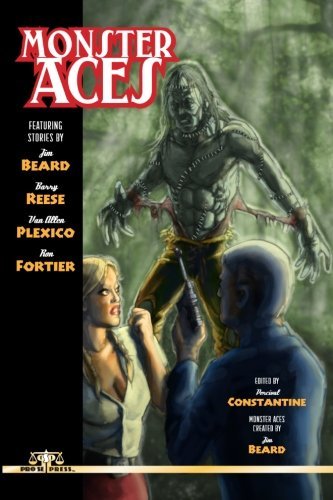
I’ve got two pieces of news for you today. The first is that Pro Se Productions has just released a new book in time for Halloween, called Monster Aces! Here is the description from Pro Se:

Having selflessly abandoned their identities, their pasts and their futures, the Monster Aces are all that stand between humanity and the fell creatures that lurk in the shadows. Four men and one woman use their amazing abilities as a team to scour the globe for monsters and bring an end to their unholy existence – whatever the danger, whatever the cost.

The book includes two stories by Jim Beard, creator of the Monster Aces. Also included are stories by Barry Reese, Van Allen Plexico, and Ron Fortier! So altogether, you’ve got some great stories by some of the best New Pulp has to offer!

And this collection was edited by yours truly, so check it out! Well worth the price of admission!

The other piece of news I have is Mark Bousquet, writer of Gunfighter Gothic and Dreamer’s Syndrome, recently reviewed Dragon Kings of the Orient! Here’s a bit of what he had to say about it:

Percival Constantine sets his own course in DRAGON KINGS and Elisa is her own woman. Where this novel shines are the moments when Elisa finds herself, in the same instance, fighting both moral and physical quandaries. Her willingness to work with previous combatants when the situation calls for it, even if she doesn’t want to do it, makes her seem like a very real, very practical character. Which is important when you’ve got fox spirits and Dragon Kings running around with magical swords.

Head on over to Atomic Anxiety to check out the rest of Mark’s review! While you’re there, check out some of his work. And if you haven’t read Dragon Kings of the Orient yet, what are you waiting for? Jump over to the Novels section to see how to get yourself a copy!

National Novel Writing Month

It’s the end of October and that means we’re on the verge of yet another National Novel Writing Month.

What’s that, you say? What the hell is this all about?

National Novel Writing Month (or NaNoWriMo for short) occurs every year in November. The idea is to produce a novel of 50,000 words between the dates of November 1st and November 30th. The rules are that all the actual writing occurs just during those thirty days. You can plot, outline, etc. in advance, but you have to wait until midnight on November 1st before you enter one word into your manuscript. Of course, there’s no enforcement of this, it’s all on the honor system. And there’s no prize, except for the satisfaction of having finished a novel.

So why do it?

If you’re an aspiring writer (or a writer in a dry spell) struggling to get something on the page, an event like this can give you that kick in the pants you need. I’ve participated in it a number of times, but only actually finished once. That was my first novel, Fallen. I’ve attempted other novels since during NaNoWriMo, but they fizzled out. The other books I’ve written were not written as part of NaNoWriMo (I actually finished The Myth Hunter on the eve of NaNoWriMo 2009).

The website has forums to get encouragement from other participants and advice on all manner of things related to writing. There’s also fun things like word counters to chart your progress. You may have seen your writer friends posting progress updates on Twitter, Facebook, or blogs. I’m toying with the idea of jumping into it again, the question is which of the ideas I’ve got notes on will I focus on.

One of my favorite things about the forums are the write-in events. There are regions all over the world for NaNoWriMo and many of these regions will schedule write-ins where people meet up somewhere with their laptops, tablets, notebooks, whatever to just write. It can be a fun way to do some work, participating in an environment like that and feeding off each other’s energy.

I say it’s worth the effort if you want to write a book or even a book of short stories for that matter. If you don’t complete it, there’s no punishment and you can always continue working on the book past November. And if you complete it, you get to pat yourself on the back for a job well done and breathe a sigh of relief.

…until the editing begins, of course.

Scrivener

Ahh, writing software. Now, I know what some of you are thinking. “Why waste money on something that promises to help you be a writer when all you need is something to write with and something to write about?”

It is true that when it comes to writing software, there is no program that will do your work for you. But there are programs out there that can be very helpful with formatting and organization. And they really vary in terms of quality, features, and price (ohh especially in price). I think most writers I know tend to use the basic writing program, like Microsoft Word or its open-source cousin, OpenOffice Writer. Both of these are good and I’ve used them myself.

If you’re a scriptwriter, be it comics, film, TV, plays, or radio, then there’s a program like Final Draft, which makes the formatting stuff a breeze. And just like Word has OpenOffice, Final Draft also has a free competitor, Celtx (although Celtx has limitations, like only being able to export into other files when connected to the Internet and I’ve had problems with it frequently crashing on my MacBook).

When it comes to structuring and outlining your story, you could use something like Word or OpenOffice (and both Celtx and I believe Final Draft also have some sort of options for this). There are also programs specifically for structuring stories, like Dramatica Pro. There’s also another program, which is free, called Xmind, a program that’s great for creating mind maps and layout charts. You could also use Excel or another spreadsheet program. There are tons of different ways to structure your story, Chuck Wendig lists twenty-five of them in this blog post (and if you haven’t yet, look around Wendig’s site or buy some of his books on writing — that’s a guy who knows how to give damn-good advice in an entertaining fashion).

A few months ago, I came across a program called Scrivener, made by Literature and Latte. It’s basically an all-purpose writing program that gives you tons of different options for organizing your writing projects. You can break your story into several different documents, each one a different chapter or section, you can have separate folders and files for different books, you can import images or other data from your research, and it’s all kept in one place. There are a bunch of basic templates Scrivener provides, but you can also create your own or download some (S.M. Worth has some great ones at his site).

I’ll give you an example as a pulp writer. For my series of books focusing on Elisa Hill, I have one project file. Under a section called Novels, I have a folder for The Myth Hunter and another for Dragon Kings of the Orient. Under the Research section, I have images of the weapons Elisa uses, notes on myths I’ve looked into that I have or might use in the future, and images of places that her adventures might lead her to. I’ve also got sections for characters and settings, where I can import some of those images as well as make notes on these places. So everything is organized here in one place, which makes it a lot easier.

I could also set up a template that follows different methods of story structure, if I so choose (the previously-mentioned Worth site has some templates that do this). Here’s another example, using Randy Ingermanson’s Snowflake Method. Or pulp writers could set up a template based on Lester Dent’s Pulp Paper Fiction Master Plot.

One thing that’s helpful for me is having the option to switch between different kinds of writing templates. For the most part, I learned how to write by first writing scripts and my writing is very dialogue-heavy. So sometimes, it might be easier for me to switch to dialogue-only and I could do this by switching easily over to a screenplay or comic mode and then later converting this into prose (without having to switch between Word and Final Draft, as I did in the past). Scrivener also autosaves constantly.

Although there is a free trial, Scrivener is not a free program. It costs $45 USD, so it’s obviously not as cheap as OpenOffice or Celtx or other free writing programs. But it’s also a lot cheaper than Microsoft Word, Final Draft or Dramatica Pro (which cost $100 on the cheap end). And personally, it seems to be able to do everything those programs can do, and then some. So $45, for me anyway, is a great deal. I like being able to have all the elements of my stories in one place as opposed to hunting around my apartment for loose notes or digging through my hard drive or various external drives, trying to remember where I saved some files that now I need.

As a guy who has a tendency to be horrible with organizing my stuff, it’s been very helpful for me. If you have the same problems as I do, you might want to check out the trial version. It’s a thirty-day trial, but I paid for a license after the first day.